uk-saas·11 min read·
UK SaaS VAT place of supply 2026: B2C EU sales, B2B reverse charge, OSS Non-Union registration, and the US sales-tax trap
You are a UK-based SaaS founder, your first paying customer is in Berlin, your second in San Francisco. Stripe charges them whatever you tell it to. VAT? Place of supply rules say two different things depending on B2B vs B2C - and post-Brexit the UK is a non-Union supplier of digital services. Get it wrong and HMRC will not refund you. This is the 2026 decision matrix.
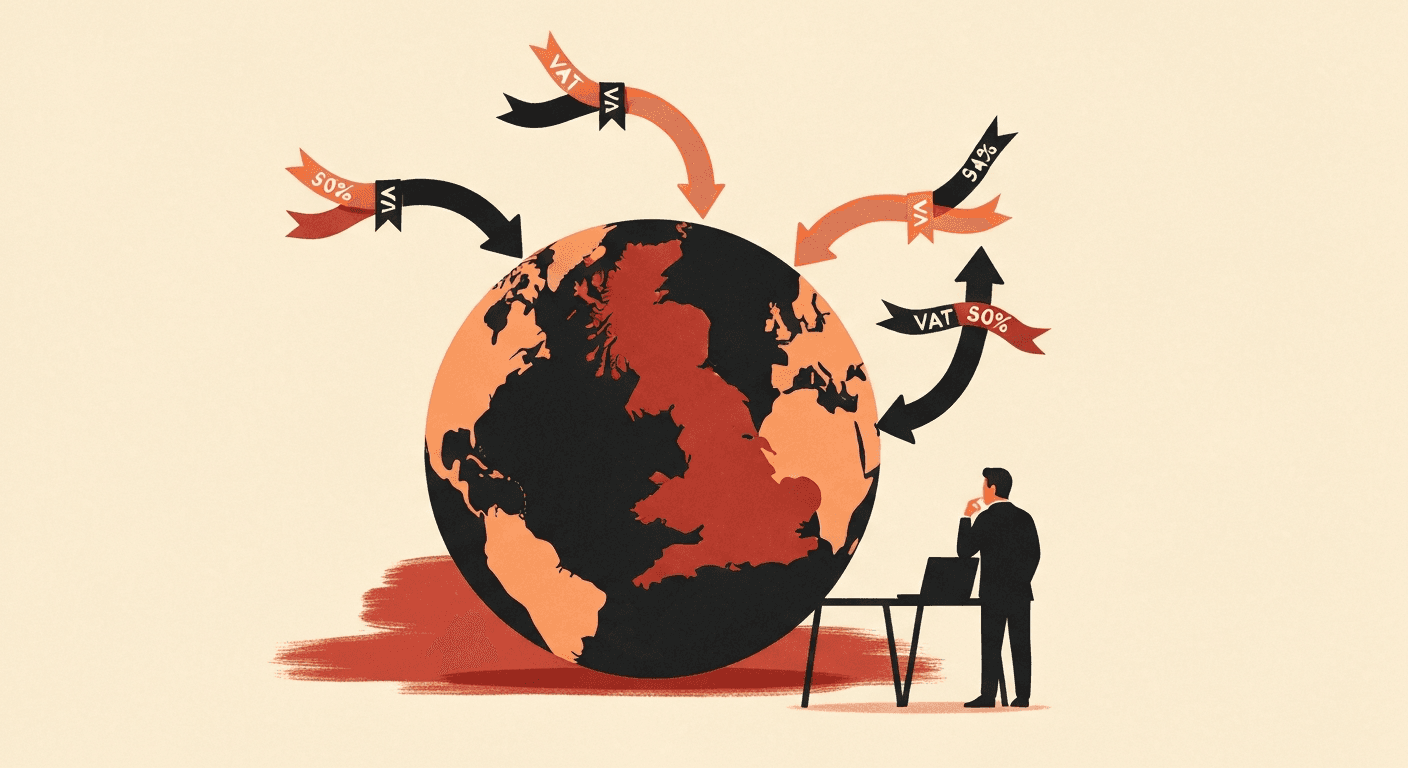
You're a UK-based SaaS founder. You shipped on a Sunday afternoon. By Monday lunchtime your first paying customer is in Berlin, and by Tuesday your second is in San Francisco. Stripe is happily charging both of them whatever you told it to charge. Lovely.
Now the awkward bit. The VAT treatment of those two customers is completely different — and it's nothing to do with what your accountant explained when you registered the company. Place of supply rules say VAT is owed where the customer sits, not where you sit. Get it right and Stripe Tax handles 80% of the work. Get it wrong and HMRC will not refund you the VAT you should have collected from a German consumer in March. They'll just send you the bill, with interest.
This post is the sequel to our UK SaaS VAT registration guide. That one covered the domestic side — the £90k threshold, voluntary registration, flat rate. This one covers everything that happens the moment you cross a border.
The big picture: place of supply is not place of seller
The single sentence that unlocks the whole topic: VAT is charged where the customer is, not where you are.
For physical goods this has always been true-ish. For digital services — anything delivered electronically, which covers practically every SaaS product — it has been unambiguously true since the EU's 2015 reforms, and unambiguously more complicated for UK sellers since 1 January 2021 when Brexit took the UK out of the Union OSS scheme.
That single principle is why selling £100/month to a French startup, a French consumer, a Texan agency, and a Texan retiree produces four different VAT outcomes. Let's walk through each.
B2C in the UK
This is the easy one. Until your trailing twelve-month UK-taxable turnover crosses £90,000, you don't have to register for UK VAT. You can register voluntarily before that — useful if your customers are themselves VAT-registered businesses who can reclaim, less useful if you sell to consumers.
Once registered, you charge 20% UK VAT to UK consumers. Stripe Tax can be told your VAT registration number and will apply it automatically. File quarterly via Making Tax Digital. Done.
Detail covered fully in the VAT registration guide. We'll move on.
B2C in the EU after Brexit — the OSS Non-Union trap
This is the section that catches almost every UK builder out.
Pre-Brexit, a UK SaaS selling to EU consumers used the EU's Union OSS scheme: register once in your home country, charge each customer their local VAT rate, file one quarterly return. Tidy.
Post-Brexit, the UK is no longer in the Union, so a UK seller is now a "non-Union" supplier of electronically supplied services. The good news: the EU still has a one-stop-shop for you. The bad news: it's a different one, and it has a brutal threshold.
Here's the rule: as a non-Union supplier of digital services to EU consumers, there is no de minimis threshold. From the very first euro of B2C revenue from any EU country, you owe that country's VAT at its local rate. Local rates range from 17% (Luxembourg) to 27% (Hungary), with most clustered between 19% and 23%.
Without OSS you'd have to register for VAT separately in every EU country you sell to. That is not a sensible life choice for a solo founder. So instead you register for the Non-Union OSS scheme in one EU member state of your choosing. You then file a single quarterly OSS return there, listing how much VAT you owe to each member state, and that country's tax authority distributes it.
The popular pick for UK founders is Ireland — same language, similar legal traditions, SEPA-friendly, no requirement for an Irish business presence. We'll walk the registration in a moment.
For now, internalise this: the moment a German, French, Spanish or any other EU consumer pays you for a SaaS subscription, you owe their country's VAT. Not yours. Theirs. From the first euro.
B2B in the EU — reverse charge
B2B is mercifully simpler. When you sell SaaS to a VAT-registered business in another EU country, the supply is reverse-charged under Article 196 of the EU VAT Directive. In plain English:
- You collect the customer's EU VAT number.
- You verify it on VIES (the EU's free online checker —
ec.europa.eu/taxation_customs/vies/). - You issue an invoice with 0% VAT and the wording "VAT reverse charge — Article 196".
- The customer self-accounts for VAT in their own country.
No money flows for VAT. No OSS return entry for that sale. The customer's accountant deals with it on their side.
Three things to remember. Verify every VAT number — VIES is free, takes two seconds, and an unverified or expired number means you have to charge VAT as if the customer were a consumer. Save the VIES check — screenshot or PDF, attach to the invoice, keep for six years. Stripe Tax does this for you if you enable EU VAT number capture at Checkout, which we'll cover below.
B2B and B2C in the US — there is no federal sales tax
Here is where UK founders get a pleasant surprise followed by a nasty one.
The pleasant surprise: the US has no federal VAT or sales tax. Nothing federal to register for.
The nasty one: every US state has its own sales tax, and most have economic nexus rules that say once you cross a threshold of sales into that state, you must register, collect, and remit state sales tax — even though you're not physically there.
The post-Wayfair (2018) economic-nexus thresholds typically sit at one of two trigger lines:
- $100,000 in sales in the state in the trailing twelve months, or
- 200 separate transactions in the state in the trailing twelve months,
though several states have moved off the 200-transaction trigger and a few use $500,000. The states that come up most for UK SaaS founders are California, Texas, New York, Washington, Florida, Illinois, and Pennsylvania.
Two practical bits. First, most US states tax SaaS as a taxable digital service, but a chunky minority — including California — historically have not taxed pure SaaS to business customers, and several others tax it only when delivered with downloadable software. The rules genuinely vary state by state and they change. Don't try to keep this in your head. Second, use Stripe Tax or TaxJar to monitor your exposure. They will flag when you cross a state's threshold and tell you to register.
Until you cross a state threshold, you don't owe anything. Most UK-based SaaS startups don't trip a single US state in their first two years. But the day you sign a £20k US enterprise customer is the day to check.
Decision matrix
Here it is on one screen. Bookmark this.
| Customer location | Customer type | What you charge | What you do |
|---|---|---|---|
| UK | Consumer (B2C) | 20% UK VAT (once registered) | File quarterly via MTD |
| UK | Business (B2B) | 20% UK VAT (once registered) | Standard UK invoice |
| EU | Consumer (B2C) | Customer's local VAT rate (17–27%) | OSS Non-Union return, quarterly |
| EU | Business (B2B, valid VAT no.) | 0% — reverse charge | Verify VIES, invoice wording, no OSS entry |
| US | Consumer (B2C) | State sales tax once nexus crossed | Register in state, collect, remit |
| US | Business (B2B) | State sales tax once nexus crossed (where SaaS is taxable) | Register in state, collect, remit |
| Rest of world | Either | Usually nothing — but check the country | E.g. Australia, Norway, Singapore have their own digital-services rules over local thresholds |
That last row is the one most builders ignore until they get an email from the Norwegian tax authority. Australia (GST), Norway (VAT), Switzerland (VAT), Singapore (GST), Canada (GST/HST) all have low thresholds for foreign digital sellers. Stripe Tax tracks them. If you're not on Stripe Tax, just monitor your largest non-EU non-US revenue countries quarterly.

OSS Non-Union registration — the Ireland route
Most UK SaaS founders register for OSS Non-Union in Ireland. Here's why and how.
Why Ireland. English-speaking. Common-law-adjacent legal heritage that makes the forms feel familiar. Strong digital-services tax practice. SEPA payments. No requirement for a physical Irish presence — you register as a non-established taxable person.
How. You apply via Irish Revenue's online portal ROS (Revenue Online Service). You'll need:
- Company details (UK Companies House number, registered address, directors)
- A point of contact and email
- Bank details for the SEPA account that will receive any refunds
- Confirmation you make B2C digital supplies into the EU
- A start date
Approval typically takes three to four weeks. Once approved, you receive an EU VAT identification number specifically for OSS use (it starts EU followed by digits — distinct from your UK VAT number, which still exists for UK domestic VAT).
You then file a single OSS return quarterly (calendar quarters: Jan-Mar, Apr-Jun, Jul-Sep, Oct-Dec). The return is due by the end of the month following the quarter end. So Q1 is due 30 April, Q2 by 31 July, and so on. You pay in euros via SEPA in one lump sum, and Irish Revenue distributes to each member state based on what you reported.
Late filing or payment triggers fines and, eventually, removal from the scheme — at which point you'd have to register in every EU country you sold to individually. Don't be late.
Stripe Tax — what it does and what it does not
Stripe Tax is the closest thing to a magic button for this. Turn it on and:
- It detects customer location at checkout (IP, billing address, card BIN).
- It applies the correct VAT or sales tax rate automatically.
- It collects EU VAT numbers and validates them against VIES in real time, applying reverse charge when valid.
- It monitors registration thresholds in every supported country and US state, and emails you when you're approaching one.
- It produces per-country tax reports ready to drop into your OSS return.
Worth being clear about what it does not do:
- It does not file your OSS return. You still file it via Irish ROS quarterly.
- It does not register you for UK VAT, OSS, or US state sales tax. You handle the registrations.
- It does not know your business model. If you sell something that's exempt or zero-rated in some country, you have to tell it.
- It does cost — currently 0.5% on each transaction in supported countries (with a slightly higher rate in some markets). For a £100 MRR customer that's 50p a month. Worth it.
Pair Stripe Tax with a clean EU VAT number capture field on Checkout and you have ~80% of compliance running on autopilot. The remaining 20% is registration, the quarterly OSS return, and watching the US-nexus dashboard.
Five mistakes solo SaaS founders make
- Assuming UK VAT applies to EU customers. It does not. Charging 20% UK VAT to a Berlin consumer is wrong twice over — you don't owe it to HMRC, and you do owe German VAT instead.
- Missing the OSS no-threshold rule. People assume there's a £90k-style threshold for EU sales. There is not, for non-Union OSS. The first euro counts.
- Not collecting and verifying EU VAT numbers. A B2B sale without a VIES-verified VAT number is treated as B2C — meaning you should have charged the customer's local VAT rate. Many founders just trust the number the customer typed in; HMRC and EU authorities don't.
- Ignoring US economic nexus. Tracking US revenue by state sounds tedious, but a single $100k enterprise client in California can flip you into nexus overnight. Stripe Tax / TaxJar makes it free.
- Double-charging on B2B reverse-charge transactions. Either the founder forgets to switch to 0% and reverse-charge wording, or charges UK VAT to an EU business that then can't reclaim it. The customer politely asks for a refund, and the bookkeeping gets messy.
30-minute ship-it
If you have thirty minutes and a coffee, do these in order:
- Audit your Stripe customers by country. Stripe → Payments → filter by country. Note which countries you have customers in and roughly what monthly revenue from each. This tells you what compliance you actually need today vs theoretically might need.
- Register for OSS Non-Union via Irish ROS if you have any EU B2C revenue at all. Three to four weeks for approval, so start now even if revenue is small.
- Switch on Stripe Tax in your Stripe dashboard. Settings → Tax → enable. Add your UK VAT registration if you have one, and your forthcoming Irish OSS number once issued.
- Update Stripe Products with location-based tax behaviour. Mark each product as "digital service — electronically supplied" so Stripe Tax applies the right rules.
- Enable EU VAT number capture on Stripe Checkout. Settings → Checkout → Tax IDs → enable for EU. This handles reverse charge automatically when a valid number is supplied.
- Add a reverse-charge invoice template. In your invoice settings, ensure B2B EU invoices include the line "VAT reverse charge — Article 196 of Directive 2006/112/EC". Stripe-generated invoices include this automatically when reverse charge applies; if you send your own invoices, hard-code it.
Thirty minutes of admin saves you a year of "should I have charged VAT on that?".
Wrapping up
Place of supply is the rule that decides everything. UK customer? UK VAT. EU consumer? Their VAT, via OSS. EU business with a VAT number? Reverse charge. US? Watch your state thresholds. Rest of world? Mostly nothing, but check.
Get OSS Non-Union registered, switch on Stripe Tax, capture EU VAT numbers at checkout, and you've handled the structure. The rest is filing quarterly and not panicking.
Two related reads:
- UK SaaS VAT registration: voluntary, threshold, flat rate scheme 2026
- UK SaaS founder PAYE: registering for your first salary with HMRC 2026
Subscribe for next week's free report. Every week we send a UK-builder-shaped deep-dive — VAT, hiring, tooling, market gaps. No fluff. Subscribe here.
Frequently asked
Do I need to register for OSS if I only have one EU consumer customer paying £10/month?
Technically yes — the non-Union OSS scheme has no threshold, so any B2C digital sale to the EU triggers a VAT obligation in that country from the first euro. In practice, many founders ignore this until revenue grows; it is a real risk if a tax authority audits and they ask. Register early, file zero or near-zero returns until volume picks up.
What if my EU customer is a sole trader without a VAT number?
Treat as B2C. A sole trader without a VAT number is, for VAT purposes, a consumer. Charge their local VAT rate via OSS. If they later get a VAT number, switch them to reverse charge from that date.
Can I register OSS in Germany or France instead of Ireland?
Yes — non-Union OSS lets you pick any EU member state. Ireland is the popular UK pick because of language and ease of dealing with Revenue. France and Germany work but have heavier-touch portals.
Does Stripe Tax support the OSS Non-Union scheme directly?
Stripe Tax produces per-country reports that drop straight into the OSS return. It does not file the return for you — you still need to log into Irish ROS each quarter and submit the figures.
Do I need to charge VAT on free trials?
No. Free trials with no payment are not a supply for VAT purposes. Once the trial converts to a paid subscription, place-of-supply rules apply from the first paid period.