indie-hacker·9 min read·
Stripe Atlas UK alternative for indie hackers in 2026: sole trader vs Ltd in 4 hours, with a decision tree by revenue
Stripe Atlas is the Delaware C-corp incorporation route US indie hackers default to. For a UK-resident indie hacker trading in the UK it adds US tax filings, foreign-resident complexity, and zero practical benefit. This post is the UK-native alternative: sole trader in 10 minutes via HMRC for free (suits GBP 0 - 40k revenue), or Ltd via Companies House in 4 hours for GBP 50 (suits GBP 50k+ or contracting). Decision tree by revenue, full Saturday morning checklist, and the Stripe + bank + accounting stack that fits each.
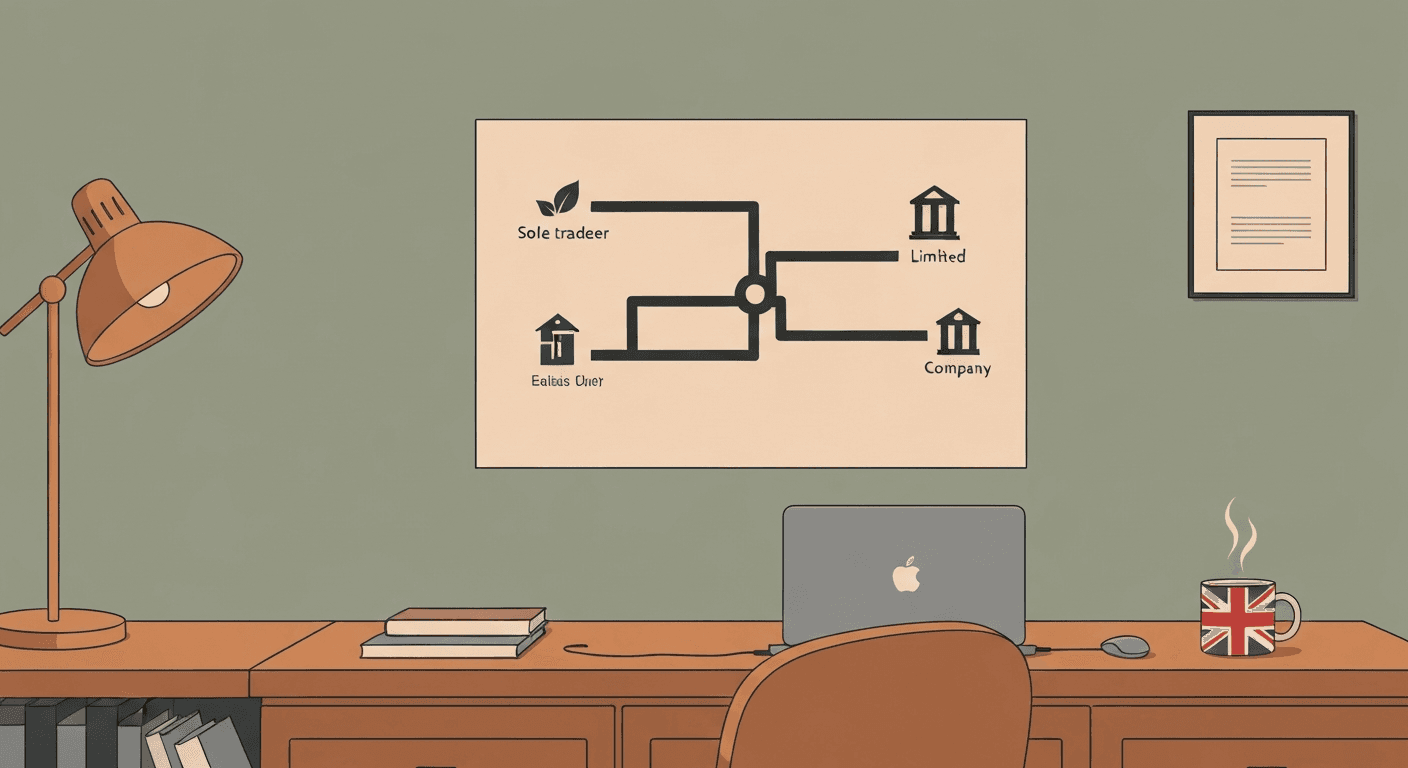
You shipped the thing. The Lovable build is live, Vercel is humming, Supabase is holding the schema together, and the first stranger paid you GBP 9 for it. Now your brain trips over a question with a US-shaped answer: do you need Stripe Atlas? The IndieHackers thread you half-read says yes. The Stripe Atlas landing page costs USD 500 and promises "your company in a day." It is also, for almost every UK resident shipping to UK customers, the wrong tool. You can be incorporated in the UK by lunchtime for GBP 50, paid through Stripe by tea, and back to coding by dinner. Here is the UK-native walkthrough - sole trader vs Ltd, the 4-hour Saturday checklist, and a decision tree by revenue.
Why Stripe Atlas is the wrong default for UK indie hackers
Stripe Atlas spins up a Delaware C-corp, a US business bank account, and the share structure American VCs expect. For a US founder chasing US VC, clean stack. For a UK resident shipping to UK customers, it imports problems you do not have:
- You become the director of a US company. That triggers an annual US corporate return (Form 1120), Delaware franchise tax (minimum USD 400/year), and a US registered agent fee (USD 100-300/year). None of those go away just because you live in Sheffield.
- HMRC still wants its cut. UK tax residency is about where you live, not where the company is registered. You file in two jurisdictions and pay a UK accountant to untangle it - quotes start around GBP 1,500/year.
- No UK trading benefit. Stripe accepts UK sole traders and Ltds directly. No payment rail opens up because your company is in Delaware. The "easier Stripe access" pitch was true in 2018; it has not been true for years.
- Banking is harder, not easier. A UK resident running a Delaware company ends up on Mercury, which works until it doesn't. Tide, Mettle, Starling Business, and Monzo Business will open a UK business account in under an hour if your company is UK-registered. They will not touch a Delaware C-corp without serious paperwork.
The legitimate Atlas use case is narrow: explicitly chasing US VC, want a Delaware C-corp on the cap table from day one, willing to pay the dual-jurisdiction overhead. If that is not you, skip it.
The two UK options that actually fit
UK indie hackers have two structures worth considering. Both are quick, both let you take Stripe payments, and both scale further than most builds will ever need.
Sole trader: 10 minutes, free, the right answer below GBP 40k revenue
Sole trader is the UK equivalent of "just start." You register as self-employed with HMRC, get a Unique Taxpayer Reference (UTR), and you are trading. About 10 minutes on gov.uk, costs nothing. Sign in with your Government Gateway ID, fill in the SA1 form, wait 10 working days for the UTR.
No Companies House. No public filings. No annual accounts. Business income goes on your personal Self Assessment each January, and you pay Income Tax (20% / 40% / 45% bands) plus Class 4 NI (6% above GBP 12,570, 2% above GBP 50,270 in 2026/27) on the profit.
Where it shines: revenue between GBP 0 and roughly GBP 40-50k. Below this, the admin saved offsets any tax efficiency a Ltd would offer.
Where it stops working: higher-rate Income Tax on profit (GBP 50,270+), wanting to retain profit in the business, taking on a co-founder, or a corporate customer's procurement form refusing to onboard sole traders. That last one is more common than expected at the GBP 5k+ B2B contract level.
Limited company: 4 hours, GBP 50, the right answer above GBP 50k revenue or any time you want salary + dividends
A UK Ltd is a separate legal person. You incorporate via Companies House for GBP 50, get a Company Registration Number the same day (often within 3 hours), and you are off. The company pays Corporation Tax on profit; you pay yourself via salary, dividends, or both.
A 4-hour Saturday:
- Hour 1 - Companies House. Register at gov.uk/limited-company-formation. GBP 50 by card, name confirmed in minutes, certificate of incorporation by email within 3 hours. No formation agent needed for a single-director company. Pick a name, a registered address (home is fine, or a virtual office for GBP 12-20/month), standard model articles. Issue 100 ordinary shares to yourself at GBP 0.01 each.
- Hour 2 - business bank. Tide, Mettle, or Starling Business will open an account inside an hour once your CRN exists. Tide is fastest (often 30 minutes), free tier solid. Mettle (NatWest-owned) is free and well-built. Starling Business is GBP 7/month with the strongest app. Pick one; you can switch later.
- Hour 3 - Stripe and accounting. Sign up to Stripe with the company name, CRN, and new business account. Instant approval for most UK Ltds. Connect to FreeAgent (GBP 19/month, free with Mettle), Xero (GBP 16/month starter), or QuickBooks (GBP 14/month).
- Hour 4 - admin. Register for Corporation Tax with HMRC (3 months from start of trading; do it now). Set up payroll if you plan to take a salary - HMRC's Basic PAYE Tools is free. Add the company details to Lovable, Vercel, and Supabase billing so VAT invoices come through correctly later.
By 1pm you have a company, bank account, payment processor, and books. Total cash cost: GBP 50 plus accounting tool.
Where it shines: revenue above GBP 50k, contracting income, retaining profit for reinvestment, partnerships, anything needing to look like a "real" company on a procurement form. Clean separation of personal and business liability.
Where it costs: Confirmation Statement (GBP 34/year), annual accounts, Corporation Tax return, PAYE if you take a salary. Roughly GBP 800-1,500/year in admin overhead for a typical solo Ltd including an accountant. Worth it once Corporation Tax efficiency beats the admin - around GBP 50k profit.
The comparison table
| Dimension | Sole trader | UK Ltd company | Stripe Atlas (Delaware C-corp) |
|---|---|---|---|
| Cost to start | GBP 0 | GBP 50 | USD 500 (about GBP 395) |
| Time to start | 10 minutes online + 10 working days for UTR | 3-4 hours including bank | 1-2 weeks |
| Public filings | None | Confirmation Statement + accounts annually | Annual Delaware report + US federal return |
| Recurring admin cost | GBP 0-200/year (accounting tool optional) | GBP 800-1,500/year typical | USD 1,500-3,500/year (US accountant + UK accountant + agent) |
| UK tax | Self Assessment, Income Tax + Class 4 NI on profit | Corporation Tax (25% main rate, 19% small profits) + personal tax on draws | Both - UK personal tax on dividends, plus US corporate filings |
| Stripe access | Direct, instant | Direct, instant | Direct, instant - no advantage |
| Banking | Personal account is technically allowed; Tide/Starling will open you a free "sole trader" account in 10 minutes | Tide, Mettle, Starling Business inside an hour | Mercury or US bank, paperwork-heavy, US address sometimes required |
| Liability | Personal - your assets are on the line | Limited to share capital (typically GBP 1) | Limited (US-style), but US courts in scope |
| Suits revenue | GBP 0 - 50k | GBP 50k+ | Almost no UK indie hackers |
| When to pick it | You are starting, validating, or running a side hustle | You have a real product, real revenue, or want salary + dividends | You are explicitly raising US VC |

The decision tree by revenue
- GBP 0 - 40k revenue: sole trader. Admin saved beats the tax efficiency you would gain. Register on gov.uk, keep receipts, file Self Assessment in January.
- GBP 40k - 100k: consider switching to Ltd. Around GBP 50k profit is where Corporation Tax + dividend treatment starts to beat Income Tax + Class 4 NI, especially if you can retain profit in the company. Below GBP 50k profit the extra admin eats the gain. Run the numbers with your accountant.
- GBP 100k+: definitely Ltd. Real money left on the table otherwise; procurement-form problem becomes constant; liability separation starts to matter.
- GBP 90k+ revenue: VAT registration is mandatory. From April 2024 the threshold is GBP 90,000 of taxable turnover in any rolling 12-month period. Register within 30 days of crossing it. Most UK indie hacker products are standard-rated at 20%. Lovable and Bolt scaffold a VAT-aware Stripe checkout if you ask.
- Any revenue, want a co-founder, salary, or to retain profit: Ltd. Structure follows intent, not just revenue.
- Any revenue, chasing US VC: Ltd first, then "flip" to Delaware later via a share-for-share exchange. Cheaper and cleaner than starting in Delaware.
Tax timing - the bit that catches people out
Sole trader. Profits are taxed in the tax year they arise (6 April to 5 April). File Self Assessment by 31 January, pay tax due plus a Payment on Account toward next year. From April 2026, Making Tax Digital for Income Tax Self Assessment (MTD ITSA) is mandatory for sole traders earning over GBP 50k; April 2027 for the GBP 30-50k band. FreeAgent and Xero are both MTD-ready.
Limited company. Pays Corporation Tax (25% main rate, 19% small profits rate up to GBP 50k profit, marginal relief between) within 9 months of year end. You take money out as salary (PAYE), dividends (Self Assessment - GBP 500 allowance, then 8.75% / 33.75% / 39.35%), or a director's loan (best avoided). The standard solo-Ltd mix: salary up to the NI secondary threshold (GBP 9,100/year in 2026/27 - no employer NI, no income tax) plus dividends up to the basic rate band.
The salary-plus-dividend pattern is why most UK indie hackers eventually go Ltd. Meaningfully more tax-efficient than pure Income Tax + NI once past the basic rate band.
The 4-hour Saturday checklist
Print this, run through it, ship by lunchtime:
- 09:00 - Companies House: register Ltd at gov.uk/limited-company-formation, GBP 50, model articles, 100 shares at GBP 0.01.
- 09:30 - wait for confirmation email with CRN. Make a coffee.
- 10:00 - open Tide or Mettle business account using the CRN. 30-45 minutes including ID verification.
- 10:45 - sign up to Stripe with the company name, CRN, and new business account.
- 11:00 - sign up to FreeAgent (free with Mettle) or Xero, connect bank feed and Stripe.
- 11:30 - register the company for Corporation Tax with HMRC at gov.uk/limited-company-formation (do it now while you remember).
- 12:00 - update billing on Vercel, Supabase, Lovable, Cursor, Claude Code, and any other tooling so VAT invoices show the company name. Saves a tidy-up later.
- 12:30 - update your Stripe products and prices to the new account, swap the API keys in Vercel env vars, redeploy.
- 13:00 - test a real GBP 1 payment end-to-end. If it lands, you are done. Lunch.
You do not need a formation agent, a company secretary, or a London accountant on retainer. None of those are bad to have eventually; none of them are required to start.
What to skip
- Stripe Atlas, for the reasons above.
- Formation agents charging GBP 100-300. Companies House does it for GBP 50 directly, same day.
- A virtual office address before you need one. Your home address on the public register is fine for most builds. Switch (GBP 12-20/month) when weird marketing post starts arriving.
- An accountant before GBP 30k revenue. FreeAgent or Xero plus an hour of your time will handle a simple sole trader return.
- Trademark registration on day one. UK IPO trademark is GBP 170 for one class. Worth it past GBP 5k MRR. Not worth it for a weekend project.
CTA
Your turn to ship. Every Thursday IdeaStack publishes one deeply researched UK opportunity - keyword volumes, SERP gaps, GBP pricing, and a paste-ready builder prompt sized for Lovable, Bolt, or Claude Code. Read the latest free report and incorporate it this Saturday.
Frequently asked
When exactly should I switch from sole trader to Ltd?
The honest trigger is GBP 50,000 of annual profit (not revenue), or any time you want to retain profit in the business, take a co-founder, or sell to a customer whose procurement form will not onboard sole traders. Below GBP 50k profit the Corporation Tax + dividend route saves a small amount the extra admin eats; above it the gap widens fast. Run one year's numbers with your accountant before you flip.
Can I use Wise or Revolut as my business account?
Wise Business and Revolut Business both work for UK sole traders and Ltds, and both are fine for receiving Stripe payouts. The catch: neither is a fully-licensed UK bank - they are e-money institutions, so funds are safeguarded rather than FSCS-protected up to GBP 85k. Under GBP 10-20k it does not matter; for larger balances keep most of it in Tide / Mettle / Starling Business and use Wise / Revolut for the multi-currency edge.
Do I really need an accountant as a sole trader?
Below roughly GBP 30k revenue with a simple one-product setup, no. FreeAgent's free tier (free with Mettle) plus an hour each January will get a Self Assessment filed correctly. Once you cross GBP 30k, hit the VAT threshold, or move to a Ltd, get one. Expect GBP 500-900/year for sole trader, GBP 800-1,500/year for a solo Ltd including statutory accounts. They pay for themselves the first time they spot a claimable expense you missed.
When is the best time of year to take dividends?
The UK tax year runs 6 April to 5 April. Dividends are taxed in the year declared, not earned. Standard solo-Ltd pattern: small monthly salary (up to GBP 9,100 secondary threshold) plus quarterly or annual dividend declarations sized to keep total personal income inside the basic rate band (GBP 50,270 in 2026/27). Declaring on 5 April vs 6 April can shift a dividend between tax years - useful if you have unused basic-rate band one year and high income the next.
What is MTD ITSA and do I need to care?
Making Tax Digital for Income Tax Self Assessment is mandatory from April 2026 for sole traders earning over GBP 50,000, and April 2027 for those between GBP 30,000 and GBP 50,000. Quarterly digital updates plus a final declaration via MTD-compatible software (FreeAgent, Xero, QuickBooks, Sage). Set up MTD bookkeeping before your applicable April deadline. UK Ltd companies are not affected by MTD ITSA.
Filed under