indie-hacker·10 min read·
Indie hacker first paying customer in the UK in 2026: the GBP 14.99 user playbook from build to bank account
The first paying customer is the only signal that means anything before you have a product. Most playbooks are written by US founders who incorporated in Delaware and reached a global audience on launch day. UK indie hackers operate differently - sole trader instead of Ltd in month one, GBP pricing instead of USD, and a domestic audience that does not hang out on Hacker News. This post is the UK-native playbook: why GBP 14.99 is the right anchor, the 5-step path from build to first sale using Claude Code and Vercel, the UK distribution channel matrix, and the traps that kill the first sale.
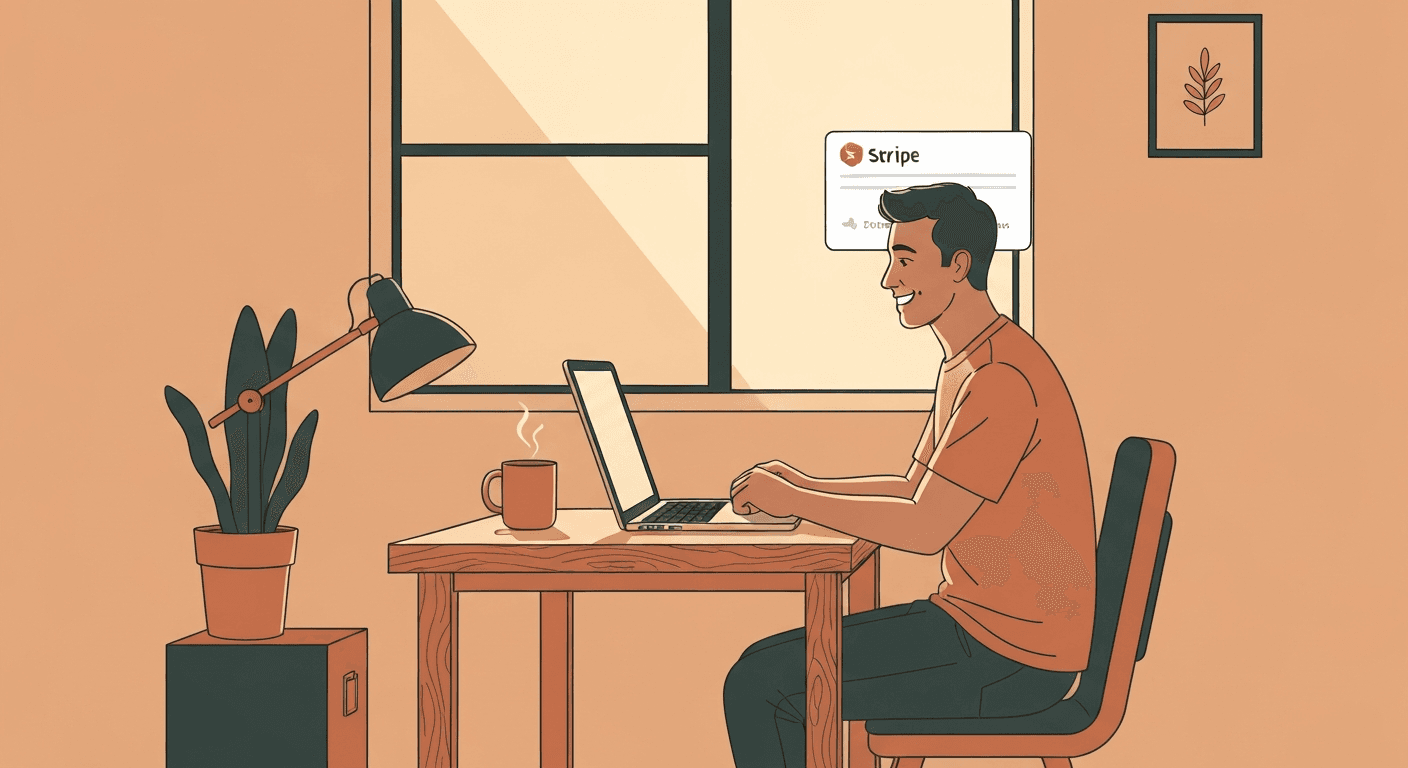
The first paying customer is the only milestone that actually changes the kind of builder you are. Search "indie hacker first paying customer" on Google from a UK postcode and the top ten results are American: Levels.io, IndieHackers.com forum threads, Product Hunt war stories, the Pieter Levels Twitter screenshot. The advice translates badly. They quote USD prices, talk about Stripe Atlas, recommend launches into time zones that are asleep when you are awake, and skip the bits that matter for a UK builder - HMRC, GBP card surcharges, the VAT threshold, and whether a Reddit post on r/SideProject at 9pm London time is going to do anything for you on a Monday morning.
The good news: in 2026 the path from idea to first GBP 14.99 in your UK bank account is shorter than it has ever been, the tools cost less than a single takeaway a week, and the playbook is straightforward. Here it is, in GBP, framed for a builder shipping from a UK postcode this month.
Why GBP 14.99 is the right anchor
Pricing your first product is mostly an emotional problem dressed up as a strategy problem. GBP 14.99 solves both. It sits in the sweet spot between "obviously a real product" and "I can decide on this without escalating to my partner." UK consumer SaaS data through the first quarter of 2026 shows the median solo-builder price point landing at GBP 12-19 per month for tools that solve one clear problem. GBP 14.99 lands inside that band with an extra micro-signal: it is not GBP 9.99 (apologetic) and not GBP 19.99 (ambitious). It says "this is worth a Wagamama lunch."
The friction maths matters too. UK card-not-present transactions through Stripe at GBP 14.99 cost you 1.5% + 20p, which is 42p, leaving you with GBP 14.57. If you sell ten of those a month, you are at GBP 145.70 net - real money, real signal, and just over the GBP 1,000 a year mark that turns "side project" into "side income" for HMRC purposes.
There is also a Hormozi-shaped reason to start here. Anything below GBP 10 trains you to optimise for volume before you have a message; anything above GBP 25 forces you to sell rather than ship. GBP 14.99 lets you focus on the build and the channel-message fit, which is what the first customer actually teaches you.
The five-step path from idea to first GBP 14.99
You are not building a unicorn this weekend. You are building one feature, for one buyer, distributed through one channel, paid for in GBP. The five steps:
1. Build the smallest paid feature with Claude Code or Lovable
Pick the one feature a buyer would pay GBP 14.99 a month to use. Not the dashboard, not the settings page, not the team-management module - the one feature. If you cannot describe it in a sentence, the brief is not narrow enough.
For Supabase-backed products with auth, RLS, and a paid tier from day one, Lovable Pro at GBP 20/month does the heavy plumbing - schema, policies, Stripe wiring - in a weekend. For frontend-led products where the value is the interface and the backend is light, Bolt Pro at GBP 16/month ships faster and the code reads cleaner. For builders who can already read TypeScript and want fine-grained control, Claude Code on the GBP 16/month Pro plan or GBP 80/month Max does the same job inside your editor with no per-message ceiling. Cursor at GBP 16/month is the daily driver if you prefer an IDE-shaped loop.
Total tooling cost for week one: GBP 16-20. Less than a Friday night curry.
2. Deploy to Vercel and a domain you actually like
Vercel's free Hobby tier handles your first hundred customers without breaking a sweat. Connect the GitHub repo, push, get a live URL in under two minutes. Buy the domain on a UK registrar (123 Reg, IONOS, Namecheap UK) for GBP 8-12 a year and point it at Vercel. The status bar in your browser saying yourthing.co.uk instead of yourthing.vercel.app does measurable work - early UK buyers are slightly more sceptical of unfamiliar TLDs than US buyers, and a .co.uk reads as "real business" without you having to say so.
3. Take payments with Stripe in GBP, not USD
Stripe will let you sign up as a UK sole trader in about fifteen minutes. You need your name, address, date of birth, and a UK bank account. They will run a soft credit check, ask for a driving licence or passport, and switch you live within the day. Set your default currency to GBP. Use Stripe Checkout for the first version - the hosted page handles 3D Secure, Apple Pay, Google Pay, and Klarna out of the box, all of which a UK buyer expects in 2026.
Two small UK-specific things. First, switch on Stripe Tax even if you are below the VAT threshold; it costs nothing to leave dormant and saves a frantic afternoon when you do cross it. Second, set the descriptor on your Stripe account to the product name, not your legal name - "OAKWELL LTD" on a card statement triggers more chargebacks than "GAMEREVIEW PRO."
4. Distribute through one UK channel - not five
The mistake nine out of ten first-time UK indie hackers make is spreading thin across Reddit, X, LinkedIn, IndieHackers, Hacker News, and a niche newsletter on day one. None of those audiences gets enough of your attention to convert. Pick one channel, post three times in a week, watch what happens. If the channel is right, the first paying customer comes from the second or third post.
A working UK distribution matrix:
| Channel | Where | Best for | First-customer signal | Effort per post |
|---|---|---|---|---|
| Reddit (UK subs) | r/SideProject, r/UKPersonalFinance, r/CasualUK if relevant, niche subs | Authentic builds with a clear problem-solver angle | One commenter says "I would pay for this" within 24h | 30-45 min |
| X (UK builder circle) | Build-in-public hashtags, reply to UK indie hackers with under 5k followers | Visual products, screenshots, demos | 3+ replies and a DM asking "where do I sign up" | 10-15 min |
| IndieHackers UK | The "Show IH" section, posted Tuesday morning UK time | Products with clear MRR potential | Comment from someone running a similar product | 20-30 min |
| Niche UK newsletter | Sponsor or guest post in a 2k-10k subscriber UK newsletter | Vertical SaaS with a defined buyer | Click-through rate above 4% | GBP 100-300 + 1h |
| Cold DM | LinkedIn or X to 20 ideal-customer profiles | B2B tools, agency-shaped products | 2+ replies asking for a demo | 1-2 min per DM |
| SEO (longer arc) | Target UK keywords with a single buyer-intent post | Products with a stable search query | Page hits position 5-10 within 6 weeks | 2-4h per post |
Pick one. Three posts. One week. Honest read. If nothing moves, change the channel before you change the product - the message-channel fit is the first thing to tune, not the feature set.
5. Ask for the sale, plainly
Most first-time UK indie hackers fail at the close, not the build. They post the demo, get a "looks great" reply, and let the conversation drift. The fix is one sentence in the post or DM: "It is GBP 14.99 a month, here is the link, the first ten signups get the first month for a fiver." That sentence does three jobs. It quotes the price, removes the friction of asking, and creates a small artificial scarcity that makes "I will think about it" feel slightly silly. UK buyers respond well to plain talk and a fair offer; they respond badly to "DM me for pricing."
If you have built the product right and picked the channel right, asking for the sale plainly is the bit that converts.

The UK tax angle - what you can ignore until later
The UK regulatory environment in 2026 is genuinely friendly to first-customer indie hackers. Most of what stops US founders dead - state sales tax, federal employer ID, payroll compliance, business licences - either does not apply or does not apply yet.
Sole trader registration is instant. Tell HMRC you are self-employed via the gov.uk online form. You get a UTR (Unique Taxpayer Reference) by post within ten working days. You file a Self Assessment once a year and pay tax on profit, not turnover. There is no fee. There is no waiting period. Your first invoice can go out the same afternoon you decide to be self-employed.
You do not need to register for VAT. The UK VAT threshold sits at GBP 90,000 in taxable turnover (rolling twelve months) through the 2026/27 tax year. Until you cross that, VAT is a future problem. If you cross it, you will know in advance and you will register. Until then, ignore it.
There is no payroll if it is just you. Sole trader with no staff means no PAYE, no employer National Insurance, no auto-enrolment pension obligation for staff. You pay Class 4 National Insurance on profits over GBP 12,570 (the personal allowance), which kicks in once you are actually making money.
Sole trader vs Limited company - not yet. The inflection point is roughly GBP 30,000-50,000 of profit per year, where the corporation tax + dividend split starts to beat the sole trader rate. Below that, the Limited company adds accountancy fees (GBP 60-150/month), Companies House filings, and director responsibilities for no tax saving. Stay sole trader through your first ten customers. Move to Limited when you can afford an accountant and the maths actually works for you.
The UK tax shape for your first GBP 14.99 customer is: tell HMRC, take the money, file once a year, sleep at night.
What the GBP 14.99 customer is actually teaching you
You are not optimising for the GBP 14.99. You are buying data. The first customer tells you four things you cannot learn any other way:
- Price elasticity. You will know within ten signups whether GBP 14.99 is roughly right, too cheap (people sign up too easily, churn fast, never refer), or too rich (everyone says "looks interesting" and no-one pays). Adjust by GBP 5 either way and run another ten.
- Channel-message fit. The channel that produced the first sale is not necessarily the channel that produces the next ten. But the message that produced the first sale almost certainly is. Save the exact post or DM and reuse the structure.
- Activation friction. Watch how the first customer uses the product in the first 24 hours. The thing they get stuck on is the thing every future customer will get stuck on. Fix it before customer two.
- Support signal. The first message they send you - bug report, question, feature request - is the most honest piece of feedback your product will ever receive. They have skin in it now. Reply within an hour. UK buyers remember a fast first reply for years.
The next ten customers
The leap from one to ten is the leap from "got lucky once" to "have a method." Three things move the needle:
- Repeat the channel. If Reddit produced customer one, post on Reddit again - same shape, different angle - within seven days. The algorithm rewards consistency.
- Ask the first customer who they know. A single sentence in your welcome email: "If you know one other person who would find this useful, I would be grateful for an introduction." Roughly 15-20% of UK first customers will respond. That is a referral channel for free.
- Write the case study. Once customer one has used the product for two weeks, ask if they would mind a short quote on the landing page. UK buyers convert on UK testimonials. A
Sarah, indie hacker, Bristolbyline outconverts a glossy logo.
By customer ten you should be at roughly GBP 150 MRR (allowing for one churn), have a repeatable channel, a tested message, and a case study on the page. That is the foundation for the next thirty.
Common traps - what kills the first sale
Five patterns kill more first sales in the UK than any other:
- Pricing pages that hide the price. "Contact us for pricing" on a GBP 14.99 product reads as "we do not know what we are doing." Show the number on the page.
- No UK postcode in the footer. A small thing, but the absence of a UK address makes UK buyers wonder if you are a US shell. A line like
Made in Bristol, UKis enough. - Stripe in test mode. Embarrassingly common. Do a real GBP 14.99 charge to your own card on launch day. Refund yourself. Confirm it cleared.
- Asking for too much on signup. Email and password, that is it. Phone numbers, company size, and "how did you hear about us" all lose conversions you cannot afford to lose.
- Vanishing after launch day. UK buyers who saw your launch post and bookmarked it will come back on day three or day seven. If your last post was a week ago and your last reply was longer ago than that, they will quietly close the tab.
None of these are clever. All of them are common. Fix them before launch and the first sale is two weeks closer.
Your turn to ship. Every Thursday IdeaStack publishes one deeply researched UK opportunity - keyword volumes, SERP gaps, GBP pricing, builder prompts sized for Lovable, Bolt, or Claude Code. Read the latest free report and ship it this weekend.
Frequently asked
Do I need to register for VAT to take my first GBP 14.99 customer?
No. The UK VAT threshold is GBP 90,000 in rolling twelve-month taxable turnover for the 2026/27 tax year. Until you cross it you can take payments in GBP without registering. You can voluntarily register earlier if you sell mostly to VAT-registered businesses (so they reclaim the VAT and you reclaim input VAT on tooling), but for B2C consumer SaaS, voluntary registration usually loses you 20% margin you do not need to lose.
Should I be a sole trader or a Limited company for my first ten customers?
Sole trader. Registration is free and instant via gov.uk. Limited companies make tax sense once your profit is above roughly GBP 30,000-50,000 a year - below that the GBP 60-150/month accountancy fees and Companies House filings cost more than they save. Stay sole trader through customer one to ten, switch when the maths and your accountant agree.
How long does Stripe UK take to set up?
Sign-up takes about fifteen minutes - name, address, date of birth, UK bank account, and a photo of your driving licence or passport for verification. Stripe usually approves the same day for UK sole traders and Limited companies, sometimes within an hour. You can take live GBP payments before lunchtime if you start before breakfast.
Do I need a pension if I am a sole trader earning from my side project?
There is no obligation, but there is an opportunity. As a sole trader you can pay into a SIPP (self-invested personal pension) and claim 20% basic-rate tax relief on contributions, with another 20% claimable via Self Assessment if you are a higher-rate taxpayer in your day job. For a side hustle making GBP 200/month, paying GBP 100 of that into a SIPP is the highest-return move you can make. Vanguard, AJ Bell, and Hargreaves Lansdown are the standard UK options.
What support do I owe my first customer in the UK?
Legally, almost nothing - UK consumer law gives the buyer a 14-day cancellation right on digital subscriptions, and you must respond to refund requests within that window. Practically, you owe them a fast first reply (under an hour on launch week, under a day after that) and a clear cancellation path (one click, no "are you sure" loops). Customers who can leave easily refer more often. Customers who feel trapped chargeback.