indie-hacker·15 min read·
Product Hunt launch from a UK timezone in 2026: the indie hacker timezone-calculus playbook
Product Hunt launches start at 12:01am PT - 8:01am UK in winter, 9:01am UK in summer. UK indie hackers need a 16-hour conscious window to ride the launch through to the LA evening surge, and the most common UK failure mode is going to bed at 11pm UK and missing the peak voting hour. This post is the UK-native Product Hunt playbook: timezone calculus, two scheduling options, the UK pre-launch list, hour-by-hour launch day, and the 5 mistakes that kill non-US-maker launches.
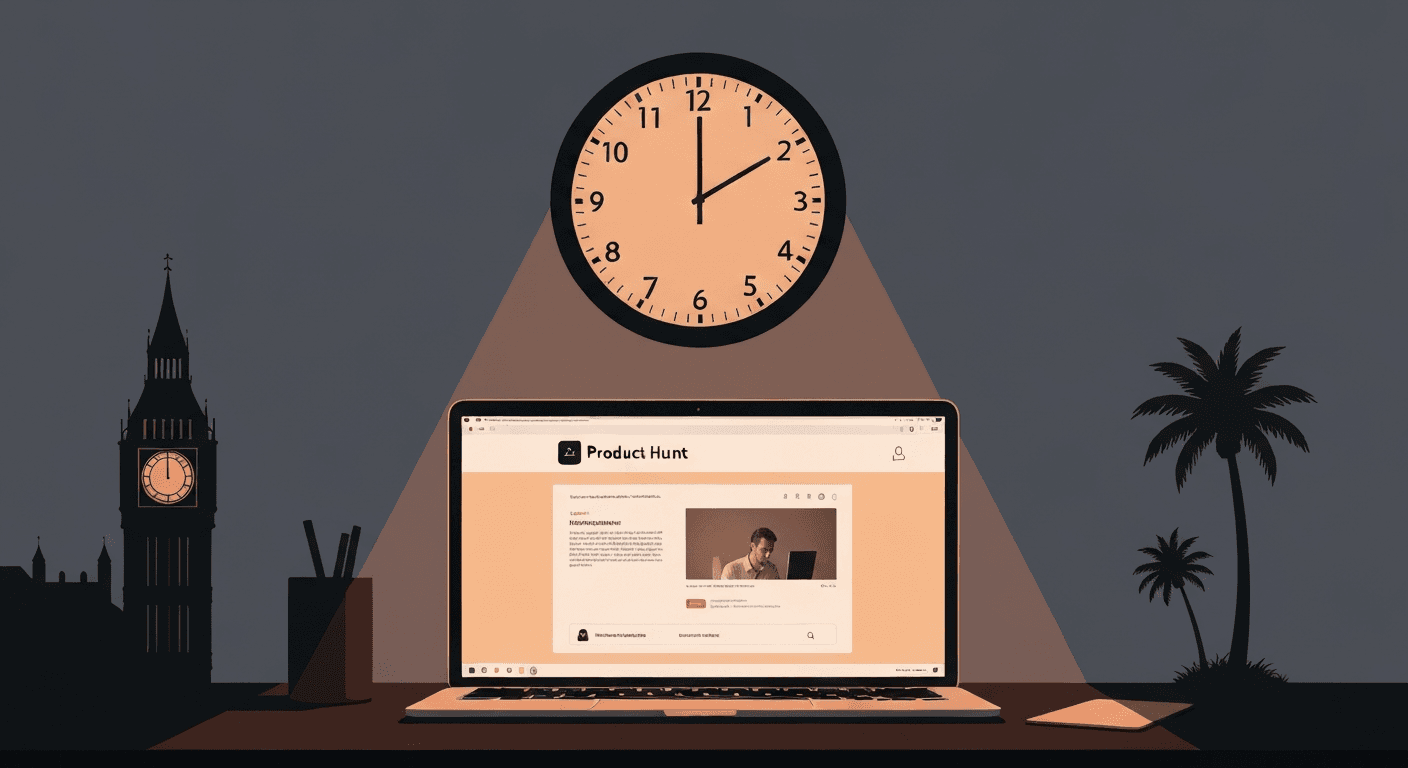
Product Hunt launch day is the only twenty-four-hour window where a UK indie hacker can borrow a US-shaped distribution channel, get on the front page in San Francisco at breakfast in London, and end the day with two thousand visitors who have never heard of you. The catch is the clock. The Product Hunt day starts at 12:01am Pacific Time, which is 8:01am UK in winter and 9:01am UK in summer, and ends twenty-four hours later when the LA evening surge is at its loudest and the average UK builder is asleep. Search "Product Hunt launch strategy" from a UK postcode and the top ten Google results are American: the Product Hunt docs, the Lenny Newsletter playbook, the Notion launch checklist, three IndieHackers threads about Pacific time. None of them talk about the timezone calculus that decides whether a UK builder lands top-five or quietly slips into the second page at midnight.
The good news: the Product Hunt loop is the same shape it has been since 2015, the bar for top-five Product of the Day from a UK timezone is lower than the SF crowd lets on, and a Tuesday launch with an honest sixteen-hour conscious window beats a Wednesday launch with five hours of attention every time. Here is the timezone-calculus playbook for a UK indie hacker shipping a Product Hunt launch this month, in GBP, with the AI-native stack that turns the polish lap from a fortnight into a weekend.
The Product Hunt loop in plain English
Before the timezone maths, the loop. Product Hunt is a daily ranking feed of new products, voted up by a global audience over a rolling twenty-four-hour window. The bones of it:
- A new "day" starts at 12:01am Pacific Time. Every product launching on that day appears on the front page from that moment.
- The window stays open for twenty-four hours. After that the product moves into the previous-day archive and the front page resets.
- The ranking inside the window is driven by upvote velocity more than raw count - votes in the first six hours weigh more than votes in the last six. Comments, follows, and outbound clicks all feed the signal.
- The prizes are Top 5 daily (your name on the front page emails the next morning), Top 3 weekly (the Sunday digest sent to the whole audience) and the headline Product of the Day (a permanent badge plus a traffic spike that tails for a week).
- The traffic tail is sharp. Day one is the spike, day two and three carry roughly half each, day seven is back to baseline unless something else picks the launch up.
That is the whole game. The hard part is not the loop. The hard part is being awake for the right sixteen hours of it from a UK postcode.
The UK timezone problem - eight hours behind, all day
San Francisco is eight hours behind London in winter (PST, when the UK is on GMT) and seven hours behind in summer (PDT, when the UK is on BST). For a Product Hunt day that starts at 12:01am PT and ends twenty-four hours later, that maps to:
- Winter (PST + GMT): 8:01am UK on launch day to 8:00am UK the next day.
- Summer (PDT + BST): 9:01am UK on launch day to 9:00am UK the next day, which is almost the easier window.
On paper that looks fine - launch over breakfast, ride it through the day, wrap up before bed. In practice the LA evening surge, where the bulk of upvote velocity from the largest single audience cohort lands, sits between 5pm and 9pm Pacific, which is 1am to 5am UK in winter and 1am to 5am UK in summer too (BST and PDT shift together). That is the four hours when a UK indie hacker is most likely to be asleep, and it is the four hours when the day is decided.
The most common UK failure mode is the eleven-pm bedtime. The builder launches at 8am UK, posts on Reddit at 10am UK, replies in the comments through the afternoon, does an X thread at 6pm UK, eats dinner at 8pm UK, posts a final "thanks everyone" at 10pm UK, goes to bed at eleven. They wake at 7am UK the next morning, find they finished sixth, and can't quite work out where it went wrong. It went wrong between 1am and 5am UK, while LA was still voting and there was no-one home to keep the loop alive in the comments.
The timezone calculus, then, is simple: the conscious window for a UK Product Hunt launch is sixteen hours, not eight. From 8am UK to roughly midnight UK (which is 4pm PT - the last meaningful spike before the LA crowd peaks). After midnight UK you are sleeping through the back half of the day, and that is fine - if you have planned for it. It is not fine if you thought the day ended at 8pm UK.
Two UK-native launch playbooks
There are two playbooks that work from a UK postcode in 2026, and they trade off against each other on lifestyle, not on result.
Playbook A - the all-day Tuesday launch
Tuesday is statistically the softest day for Product Hunt competition. Mondays are crowded with founders who held their launch over the weekend; Wednesdays and Thursdays are stacked with VCs who like a midweek announcement; Fridays leak attention into the weekend. Tuesdays land in the trough between the Monday rush and the Wednesday VC wave, and a typical Tuesday top-five threshold over the past twelve months has sat noticeably below Monday's. For a UK indie hacker without a US PR team, that two-hundred-vote softness is the single biggest gift the calendar will hand you.
The Tuesday all-day shape:
- Monday evening UK: post the "launching tomorrow" page on Product Hunt, share with your warm list, sleep early.
- 8:00am UK Tue: launch live, first social blast (X, LinkedIn, two Reddit subs), first comment in your own thread answering the obvious question.
- 8am to midnight UK Tue: sixteen hours of presence in the comments, replies on socials, a follow-up post at 10am UK, an AMA-style comment at 1pm UK, a US-wake post at 4pm UK, a "we are top X" post at 8pm UK, a final push at 11pm UK.
- Midnight UK Tue: sleep. The LA surge is happening; you are not going to influence the next four hours by being awake and exhausted.
- Wednesday UK: wake at 7am, screenshot the result, write the retro post, take a walk. Wednesday is the rest day. Trying to launch on Wednesday morning UK after a Tuesday launch is the second most common UK failure mode - the body has nothing left.
Playbook B - the shifted launch
Product Hunt lets you schedule a launch at any minute past 12:01am PT on a given day. If you schedule for, say, 8:00am PT (4pm UK winter, 5pm UK summer), you start the day with the LA crowd already half-awake, you ride peak voting from 5pm UK to 9pm UK, you sleep at midnight UK with most of the high-velocity hours behind you, and you wake to a result instead of a half-result.
The trade-off is that you have given up the early-morning votes from Asia-Pacific and Europe waking up to your launch, which is the cohort most likely to upvote a UK indie product. You will end up with a higher-quality vote curve but a lower volume. For a polished consumer product with a hunter relationship and a warm UK list, Playbook A wins. For a B2B tool or a niche developer product where the most sympathetic audience is the LA tech crowd, Playbook B wins.
Pick one. Both can land you in the top five from a UK postcode. Neither works if you launch at 12:01am PT, post once, and walk away.
Pre-launch - the two weeks before ship day
The launch is mostly decided before it goes live. Three things matter:
Hunter relationships - a small, polite ask
A "hunter" is the Product Hunt user who posts your product on launch day. Anyone can hunt their own product, but a known hunter brings their followers - and their followers vote in the first hour, which is the hour that sets the velocity curve. You do not need a famous hunter. You need an active one who likes UK indie products.
Chris Messina is the famous one (he hunts a lot, replies politely, and occasionally takes on UK products if the brief is tight). Kevin William David is the next tier and more accessible. There are also a steady cohort of UK-based hunters who actively look for UK launches - find them by browsing the "Hunters" leaderboard for accounts with UK timezone activity. The ask is one paragraph: what the product is, who it is for, why you are launching on date X, a link to a working preview, and the one sentence about why this matters now. Do not ask three weeks out and do not ask twice. One ask, two weeks before, polite, specific, with a clear date.
UK channel partners
The UK indie ecosystem has a handful of channels that meaningfully amplify a Product Hunt launch on the day. Indie Hackers UK threads pick up well-shaped launches; TechSPARK covers the Bristol and South West tech scene; Maddyness has a UK section that picks up consumer launches; The Next Web (TNW) takes UK angles when the framing is right. None of these write about you because you launched - they write about you because you sent them a one-paragraph note three days before launch, with a working demo and a clear UK angle. Send the note. Do not chase.
Warming up your own audience
The first hour of a Product Hunt launch is the most important hour in the day. The vote curve for that hour is set by the people who already know you. If your X following is two hundred and your newsletter is fifty, the first-hour ceiling is roughly that. Spend the two weeks before launch posting build-in-public updates, screenshotting one feature a day, replying in adjacent communities, and explicitly saying "launching on Product Hunt on Tuesday the X". This is not hype. This is wiring up the doorbell so the right people hear it ring.

The launch-day support stack
You do not need a war room. You need a polished product, a fast laptop, a UK kettle, and a tooling stack that lets you finish the polish lap on Sunday so you can ship on Tuesday.
- Claude Code (GBP 16/month Pro, GBP 80/month Max) for the final-week feature work, copy edits, and the inevitable Sunday-night bug fix. Pro covers a typical UK indie launch fortnight; upgrade to Max only if you are touching a large repo.
- Lovable (GBP 20/month Pro) if your launch product is a Supabase-backed app and the polish is mostly schema, auth, and Stripe wiring.
- Replit (GBP 12/month Core) for the live-demo button on your Product Hunt page - "try it now" outconverts "watch a video" by roughly two-to-one on launch day, and Replit's hosted preview holds through the spike without you doing anything.
- Bolt (GBP 16/month Pro) if the launch product is frontend-led and the value is the interface.
- Cursor (GBP 16/month Pro) as the daily driver if you prefer the IDE-shaped loop.
- Vercel free Hobby tier holds 1,000-2,000 visitors/hour without trouble, which is roughly what a top-five Product Hunt placement delivers on day one. You almost certainly do not need to upgrade.
- Stripe with Stripe Tax dormant (no VAT registration needed below GBP 90,000 turnover), GBP as default currency, and Apple Pay and Google Pay enabled in checkout. UK Product Hunt visitors expect tap-to-pay; missing it loses conversions you cannot afford to lose on launch day.
Total tooling cost for the launch fortnight: GBP 30-50. Less than a Saturday night out.
The launch-day hour-by-hour - sixteen UK hours, decoded
This is a Playbook A all-day Tuesday launch, in UK time, with the Pacific time in brackets so you can sense the curve.
- 8:00am UK (12:01am PT) - launch goes live. First X post with the link, first LinkedIn post (UK builder angle, not US), short Reddit post in r/SideProject. Reply to the first comment on your Product Hunt thread within ten minutes. The first hour sets the velocity.
- 10:00am UK (2:00am PT) - second wave. Email your warm list (newsletter, beta users, friendly UK indie hackers). Post the "we are X position" update on X. Reply to every comment that has come in. The Asia-Pacific crowd is voting from their morning; this is the hour they need to find you.
- 1:00pm UK (5:00am PT) - low point. The US is asleep and Europe is at lunch. Use this hour to write a longer-form X thread, eat properly, and answer anyone in the comments who has asked a real question. Don't push more posts now - they will land into a quiet feed.
- 4:00pm UK (8:00am PT) - the US wakes. East Coast is at breakfast, West Coast is rolling. New post on X tagged with the product category, a fresh comment on the Product Hunt thread answering "what makes this different". The vote curve picks up sharply over the next ninety minutes.
- 6:00pm UK (10:00am PT) - the US morning peak. This is your second-biggest hour of the day. Reply to every new comment, every X mention, every DM. If you have a hunter, this is when their followers are voting - thank them publicly in the thread.
- 8:00pm UK (12:00pm PT) - peak voting hour. This is the single most important hour outside the launch hour. Post the "we are top X" update everywhere. Run a short live demo on X if you can. Reply to every Product Hunt comment within five minutes.
- 10:00pm UK (2:00pm PT) - LA afternoon. Steady voting, decisions being made for the rest of the day. Last big post. Reply to anyone still in the thread.
- 11:30pm UK (3:30pm PT) - final UK push. One last post, one last round of replies, a thank-you to the hunter and the early supporters. Set tomorrow morning's first reply as a drafted comment so you can hit send before coffee.
- Midnight UK (4:00pm PT) - bed. The LA evening surge happens between 1am and 5am UK; you are not awake for it and that is fine. The work you did in the previous sixteen hours decides what happens in those four.
Wake at 7am UK Wednesday. Send the drafted reply. Screenshot the result. Write the retro thread. Walk the dog.
What good looks like for a non-US maker
A UK indie hacker shipping a polished AI-native product on a soft Tuesday with a hunter and a warm list of two hundred can realistically expect:
- Top 10 daily: very achievable. Most UK launches that follow Playbook A land here.
- Top 5 daily: achievable but contested. This is the bar where the sixteen-hour conscious window starts to pay back. Roughly four in ten well-executed UK launches over the past twelve months have hit it.
- Top 3 weekly: harder, because the weekly crown is decided by the launches that backfill across the whole week's traffic. UK launches without a US co-founder hit it less often, but it does happen and it is worth aiming for.
- Product of the Day: the prize. UK indie hackers do win it - typically launches with a strong hunter, a sharp single-feature pitch, and a polished demo. Treat it as the upside, not the target.
The honest framing for a UK first-time launcher: aim for top-five daily, plan as if top-three weekly is possible, treat Product of the Day as a bonus that justifies a celebration dinner in Bristol.
Post-launch - the seventy-two-hour follow-through
Product Hunt traffic decays fast. Day one is roughly half your launch-week traffic; day two is roughly a quarter; day three is the last meaningful spike before the long tail. The 72-hour follow-through is where the launch becomes an asset rather than an event.
- Day 2 (Wednesday UK): the retro post. Long-form X thread on what worked, what didn't, the result. UK indie hackers reliably engage with a candid retro - the post often outperforms the launch announcement itself.
- Day 3 (Thursday UK): the case-study post. One paying customer, one quote, one screenshot. UK buyers convert on UK testimonials.
- Day 4-7: UK distribution channels take over. Reddit (a deeper post in a niche sub, not r/SideProject), X (a quote-thread of a public reply), LinkedIn UK (a builder-angle post), the IndieHackers UK weekly thread, your own newsletter. Each of these adds 100-300 visitors a day for a week.
- Week 2 onwards: SEO becomes the engine. The Product Hunt page itself is a high-DA backlink, the launch press is a clutch of medium-DA backlinks, and a single buyer-intent post on your domain can pick up the long tail of "best [your category] 2026" search queries that the launch surfaced. This is where the channel-message fit you tested on launch day becomes the durable acquisition loop.
The five most common UK-launch mistakes
Five patterns kill more UK launches than any other:
- Hunting yourself. Self-hunted products land lower in the early-hour velocity curve because they have no hunter follower base voting in the first hour. Find a hunter, even a small one. The polite ask works.
- Launching on Monday or Friday. Monday is the bloodiest day on Product Hunt - launches that held over the weekend all hit at once. Friday leaks attention into the weekend. Tuesday and Wednesday are the soft days; Tuesday is softer.
- Ignoring the LA evening surge. Going to bed at 11pm UK and waking up to a sixth-place finish is the most common UK failure mode. Either accept the sixteen-hour day or shift the launch (Playbook B). Don't try to do an eight-hour day on Pacific time.
- No hunter, no warm list, no UK channel partners. All three are pre-launch work and all three compound. A launch with none of them is a launch that depends on Product Hunt's own algorithm to discover you - which it will, on page two.
- Vanishing on day two. The launch is not the day. The launch is the seventy-two hours. UK indie hackers who post once on Tuesday, sleep in on Wednesday, and disappear on Thursday lose the case-study moment, the retro thread, and most of the long tail. Show up on Wednesday too.
None of these are clever. All of them are common. Plan around them and the launch is two notches higher before you have shipped a line of code.
Your turn to ship. Every Thursday IdeaStack publishes one deeply researched UK opportunity - keyword volumes, SERP gaps, GBP pricing, builder prompts sized for Lovable, Bolt, or Claude Code. Latest free report: https://www.ideastack.co/reports - Subscribe to the newsletter and ship it this Tuesday.
Frequently asked
Should I launch on Product Hunt before I have my first paying customer?
It depends on the shape of the product. If you are pre-revenue with a free tier and a clear paid upgrade path, launch when the product feels finished - Product Hunt visitors are tolerant of new products and forgiving of "we are launching today, here is the free tier, the paid tier is GBP 14.99". If you are paid-only from day one, ship the first ten paying customers first via a single channel (see the GBP 14.99 first-customer playbook), then launch on Product Hunt with the case studies in your back pocket. The launch converts much better with the words "trusted by Sarah, indie hacker, Bristol" on the page.
Does Product Hunt still matter in 2026 for UK indie hackers?
Yes, with caveats. The platform has had its peak attention diluted by Twitter/X build-in-public and the rise of niche directories, but the algorithmic reach is still meaningful: a top-five Product of the Day placement reliably delivers 1,500-3,000 visitors on day one, a clutch of high-DA backlinks, and a permanent badge that converts UK buyers on the landing page. It is not the only channel, but it is one of the few channels where a UK indie hacker can borrow a US-shaped audience for a single day at no cash cost.
How do I find a hunter who will actually hunt my UK product?
Browse the Product Hunt "Hunters" leaderboard, filter for accounts that have hunted in the last fourteen days, and read the products they have hunted. If a hunter has a track record of hunting UK or European products, they are a candidate. DM them on Twitter/X (not on Product Hunt - the platform DMs are noisy) two weeks before launch with a one-paragraph pitch, a working demo link, and a clear date. Polite, specific, no follow-up if they don't reply. Roughly one in four cold asks lands; one in two warm asks (someone who has interacted with you on X first) lands.
Will I get banned for asking my friends to upvote?
Not for asking friends, no. Product Hunt's anti-gaming logic flags coordinated bursts of brand-new accounts upvoting in the first hour - that gets a launch quietly throttled or removed. Asking your existing audience to come and vote is the entire point of the platform, and the platform expects it. The line is between "here is the link, vote if you find it useful" (fine) and "everyone create a Product Hunt account and upvote at 8am UK" (not fine). Stay on the right side of that line.
What if my launch flops - is it worth doing again?
Yes, but not on the same product within the same year. Product Hunt allows relaunches of significantly updated products (typically 12+ months between launches), and a relaunch of a more polished product with paying customers and a real testimonial often outperforms the original launch. If your first launch landed outside the top twenty, treat it as the message-channel-fit experiment it was - keep the channel, change the message, ship a v2 with the lessons baked in, relaunch in twelve months. UK indie hackers who relaunch with a sharper pitch reliably do better the second time.