Build PEEPs and evacuation plans for UK high-rise managers
A purpose-built PEEP system for the responsible person
Executive Summary
In a nutshell
The Fire Safety (Residential Evacuation Plans) (England) Regulations 2025 went live on 6 April 2026, putting a fresh statutory duty on responsible persons to identify vulnerable residents in 12,500 high-rise buildings, run person-centred fire risk assessments, agree written evacuation plans, and share that data digitally with the local fire and rescue service. The buying audience is housing associations, RMCs and managing agents who manage these buildings, and the tooling gap is glaring: incumbents like Plentific, MRI Living and Bolster Systems handle broad compliance and repairs, but none ship a clean, audit-ready PEEP workflow with an FRS-shareable export. A focused SaaS at £30 to £200 per building per month wins on speed and audit trail while the deadline pressure is hot.
The Story
Meet the user
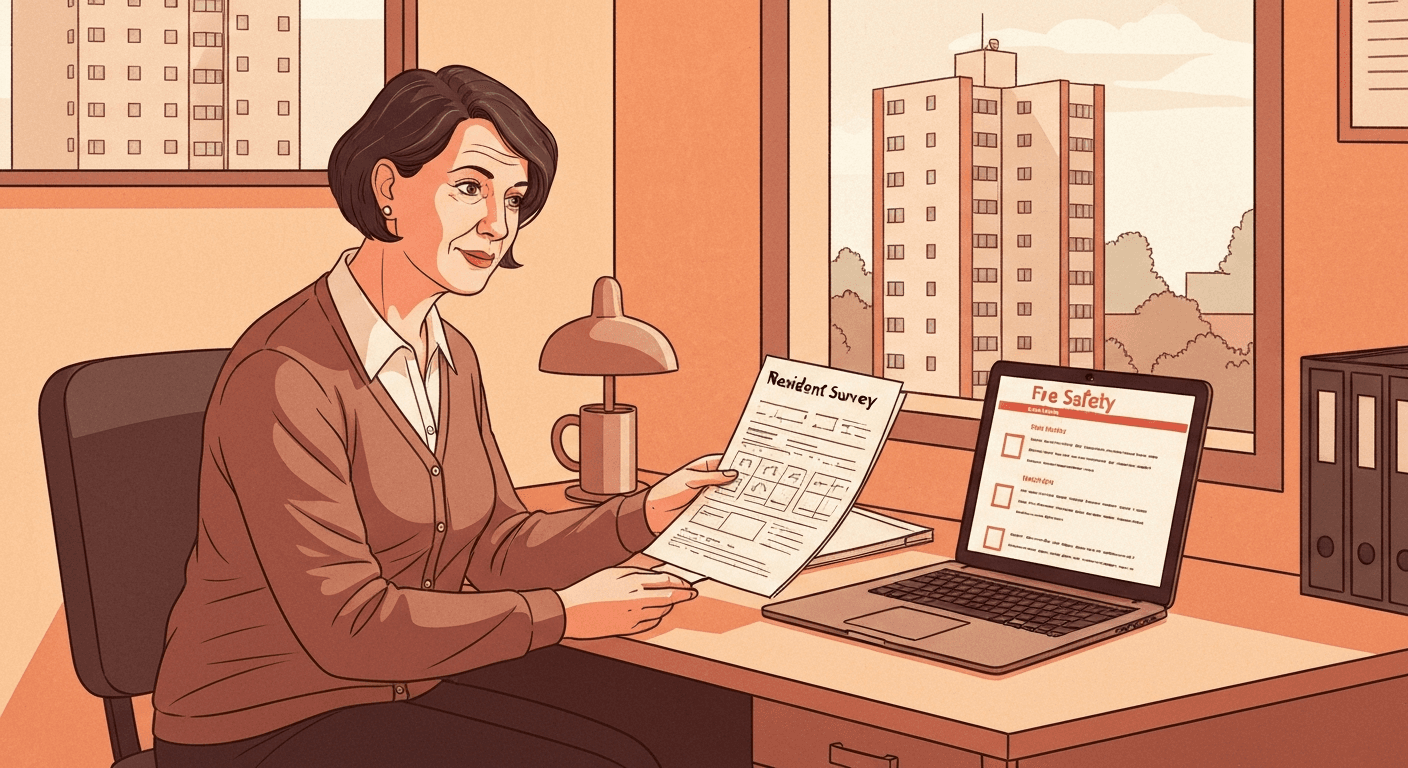
Helen runs compliance for a managing agent in south London with 47 in-scope blocks. On 6 April 2026 her CEO forwarded an email from the Building Safety Regulator with the subject line "Have you started your PEEPs yet?" and a single emoji. She knew, broadly, what was needed. Identify residents who would struggle to self-evacuate. Offer each one a person-centred fire risk assessment. Agree a written plan. Send a sanitised summary to the London Fire Brigade. Review every twelve months. What she did not have was a system. Her current setup is a SharePoint folder of resident letters, a spreadsheet that lists 11,200 leasehold units across the 47 blocks, and the contact details of three fire risk consultants who all charge a day rate. She does the maths in her head: 47 blocks, maybe 600 residents who'll engage, no two consultants storing data the same way, and an FRS portal that doesn't yet exist for half the boroughs she covers.
Then she finds a tool that lets her drop in a building, send a QR-coded self-survey to every flat, generate a draft PEEP from the responses, flag the residents who need a real assessor visit, store the audit trail, and produce a single PDF for the fire brigade. By month two her CEO stops asking. By month four she is selling the rollout to a peer at another agent over a coffee.
Scores
How does this idea stack up?
7.5/10
12,500 registered higher-risk buildings plus around 120k wider in-scope estate, fragmented buyer set, no dominant PEEP-specific incumbent.
Live statutory duty since 6 April 2026, sensitive UK GDPR data, FRS share-out is operationally novel, and search CPC of £15.54 on "fire risk assessment software" signals serious commercial intent.
Standard web stack plus form builder, PDF and CSV export, and reminder scheduler. OpenPEEP open standard already specifies the data shape.
Regulations live exactly one month ago. UK monthly search for "personal emergency evacuation plan" hit 49,500 in February 2026, up from a 12,100 baseline.
Permanent statutory duty with annual reviews, but well-funded incumbents (Plentific raised $100M Series C) could bolt this on inside 18 months.
Solo-buildable in 4 to 6 weeks, but B2B housing-sector sales cycle needs 2 to 3 months of credibility-building and one anchor reference customer.
Strongest
Timing
Live deadline plus a 4x search-volume spike in the run-up gives a true before/after moment.
Watch out
Durability
Plentific, MRI Living and Voicescape already own the buyer relationship for repairs and tenant comms. They will notice.
Pain Point
The problem
“Letters that go unanswered, intercom calls that receive no response, and residents who actively decline. All of these need to be documented carefully.”
— PIB Risk Management, on the new Responsible Person duties
The duty is sharp and the workflow is messy. Responsible persons (a category that covers building owners, landlords, RMCs, RTM companies and the managing agents acting for them) must identify residents whose ability to self-evacuate is compromised, offer each one a person-centred fire risk assessment, agree a written PEEP for those who request one, share a sanitised version of the data with the local fire and rescue authority, hold a copy in the building's secure information box, and review every twelve months or sooner if circumstances change.
Three things make this genuinely hard in practice. First, resident engagement: getting answers from 200 flats requires multi-channel chase logic (post, intercom, door-knock, email, QR code) and the regulator expects evidence of "genuine attempts." Second, the data is special-category personal data under UK GDPR (disability, mobility, contact details), so spreadsheets and shared SharePoint folders are a quiet liability. Third, the FRS share-out is brand new in operational terms, and every fire and rescue service is building its own intake. Without a structured digital format, every consultant produces a different PDF and the fire brigade has to rekey it.
The bar is not "do it perfectly," it is "show your audit trail when the Building Safety Regulator visits." That is a software problem, not a consulting problem.
Want reports like this every Thursday?
One validated UK business opportunity per week. Free.