Coach UK Year 13s through the new three-question UCAS personal statement
From £15 self-serve vs £750 plus for human tutoring
Executive Summary
In a nutshell
A guided drafting and critique tool built around the new three-question UCAS personal statement (in force for 2026 entry onwards). The reform replaces the old 4,000-character free-form essay with three structured questions and a 350-character minimum per answer. Existing AI checkers (Statementory at €7.49, Grove free, StatementReview, UniReady) all retro-fitted the new format onto old scoring engines. A purpose-built per-question rubric, university-tier tone modelling (Oxbridge, Russell Group, post-92), and an iterative draft-critique-polish loop that actually understands the prompt structure can sit between free generic ChatGPT and the £750 plus human tutoring offered by Crimson, GoStudent, and Edumentors. Sold at £15 to £30 one-off or £29 for the application cycle, with a B2B sell to sixth-form colleges as the durable revenue line.
The Story
Meet the user
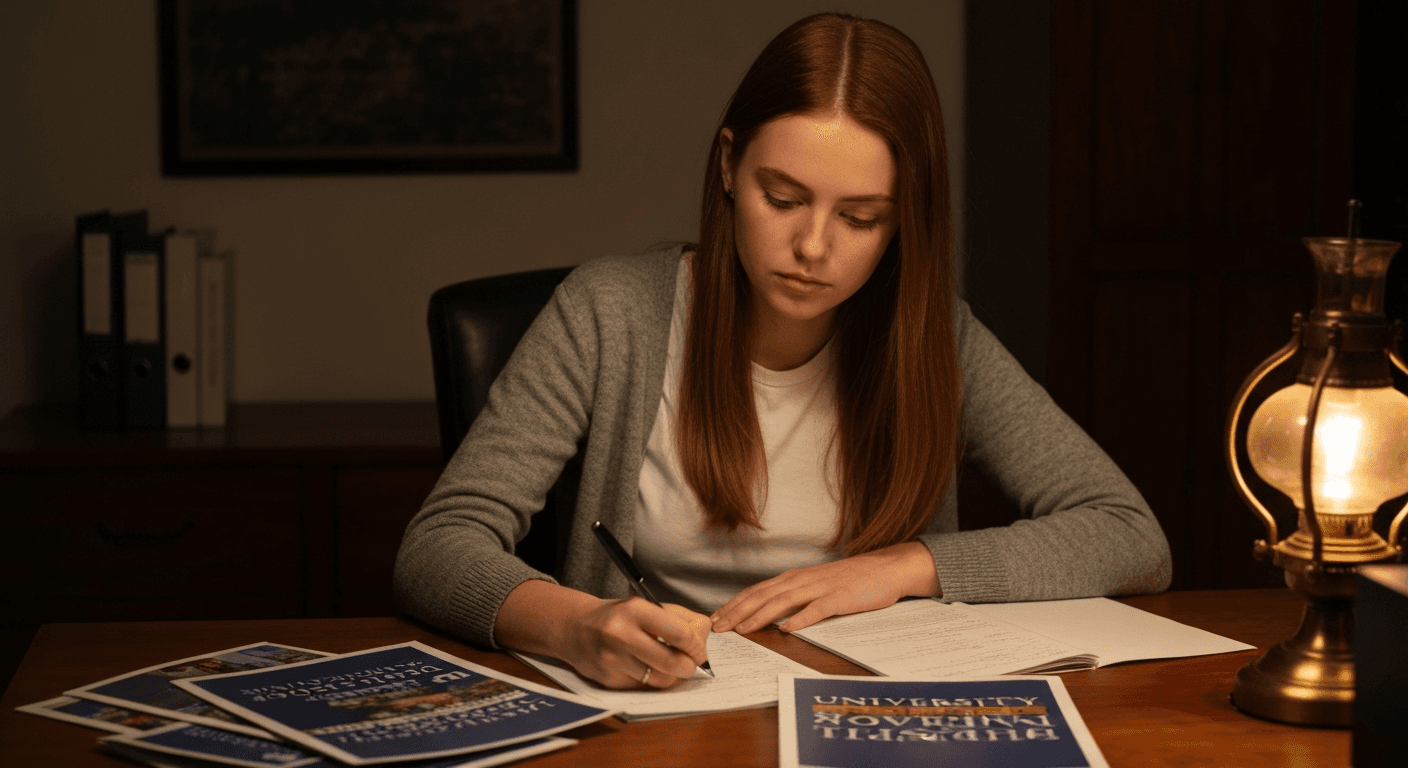
Lucy is seventeen, a Year 13 student in Sheffield, and she has been told by her form tutor that her personal statement draft needs to be with him by the second week of September. It is 9pm on the first Sunday of half term. Her laptop is open at the new UCAS portal. There are three boxes. The first one says "Why do you want to study this course or subject?" and underneath, in small grey text, "350 character minimum, count toward your 4,000-character total". She has 8 characters typed. She has read the UCAS parent slide deck her mum forwarded her. She has watched two YouTube videos. She has googled "personal statement examples" and got 2024 results that all use the old format. She tried ChatGPT, but it gave her something that read like a LinkedIn post and used the word "passionate" four times. She knows everyone applying to her course will use ChatGPT. She knows the universities know that. She does not know what to do.
Then her best mate sends her a TikTok of someone using StatementCoach.uk. £19. She pastes in her course (Geography, Sheffield, Manchester, Leeds, Bristol, Exeter), her predicted grades, and a brain-dumped paragraph about the time she did a fieldwork trip to the Lake District that genuinely changed how she thought about glaciation. The tool walks her through question one with a four-step drafting flow, scores her answer against a Geography-specific rubric on a per-question basis, flags the bit that sounds like ChatGPT, and rewrites two sentences in her own register without flattening the voice. By 10:30pm she has 1,100 characters of question one she actually likes, a draft of question two that needs work, and a notes file for question three. She closes the laptop, makes a tea, and texts her mate back: worth the £19 honestly.
Scores
How does this idea stack up?
8.1/10
~600k UCAS applicants per cycle, ~323k UK 18-year-olds, peak monthly searches for "ucas personal statement" hit 22,200 in September 2025 (UK only). Several AI checkers already exist (Statementory, Grove, StatementReview, UniReady) so this is not greenfield, but none have nailed per-question prompt-specific rubrics for the 2026 reform.
83% of students report personal statement stress (Personal Statement Service survey). New format means every YouTube tutorial, school worksheet, and tutor crib sheet from the last decade is obsolete. Single-shot stake (one statement covers all five course choices) makes willingness to pay high.
LLM with structured prompt-per-question. RAG over UCAS official guidance, sample statements, and university subject pages. Character counter, AI-detection check, voice-preservation rewrite. Standard Next.js plus Vercel plus Supabase plus Stripe plus Anthropic API. Solo build in 2-4 weeks.
First cycle of the reform is 2026 entry (applications opened September 2025). Second cycle (2027 entry) lands the same week this report goes live, with Year 13 cohorts beginning drafting in September 2026. Old format is dead. Every existing competitor is mid-pivot. The before/after moment is now.
Strong annual recurrence (each Year 13 cohort is fresh, ~600k applicants every cycle, no carryover) but the novelty premium of the reform fades by 2028 entry as schools and services normalise. After year 2-3 it becomes a commodity AI editor competing on price, brand, and integrations. The B2B school/college tier is the durability play.
Trivial technical build, but seasonal-spike demand (Sept-Nov peak, near-zero May-July) demands disciplined annual cash management. Marketing has to penetrate Year 13 audience channels (TikTok, school career advisors, sixth-form Discord/WhatsApp) which takes effort to seed. UCAS could ship a competing free version any time, non-trivial platform risk.
Strongest
Timing
The reform created a first-cycle reset that won't come around again. Anyone shipping a 2026-format-native tool by August 2026 catches the September drafting wave with a clean differentiator vs every retrofit.
Watch out
Execution Difficulty
UCAS itself ships the Personal Statement Builder as a free tool. If they upgrade it with AI critique (likely, given they reference AI guidance on their own site), the moat collapses. The defensive play is depth (subject-specific rubrics, university-tier modelling) and B2B distribution (sixth-form licences) that UCAS as a regulator-adjacent body cannot easily compete on without conflict.
Pain Point
The problem
“I tried ChatGPT but it gave me something that read like a LinkedIn post and used the word 'passionate' four times. Every YouTube tutorial I find uses the 2024 format. My school's careers advisor admitted she's still working out the new format herself.”
— Paraphrased composite from Student Room and r/6thForm threads about the 2026 transition
The 2026 reform replaced one familiar problem ("write a 4,000-character essay that sells you to five universities") with three new ones. The first question (Why do you want to study this course or subject?) is short-form motivation. The second (How have your qualifications and studies prepared you?) is academic evidence. The third (What else outside formal education?) is super-curricular. Each requires a different register and a different proof. The old advice ("hook them in the first sentence and use STAR") fragments across three answers, three rubrics, three minimums.
Obsolete content base. Every paid example service (Personal Statement Service, Getting In, projectsdeal) is selling 2024-format examples on day-one with a header that says "we've updated for 2026" but the actual training data is the old format.
Sixth-form colleges under-resourced. Form tutors and careers advisors have one September INSET on the new format and a UCAS slide deck. There is no curriculum, no marked-up exemplars by subject, and no consistent feedback loop.
Generic AI fails the structure test. ChatGPT, Gemini, and Claude treated naively will produce 4,000 characters of free-form text unaware of the per-question minimum or the prompt-specific rubric. UCAS now scans for AI similarity, so generic LLM output is also a submission risk.
Single-shot, multi-university stake. One statement is sent to all five course choices. There is no A/B test. The first draft week is the highest-anxiety week of the academic year for any Year 13 student aiming above their predicted grades.
Want reports like this every Thursday?
One validated UK business opportunity per week. Free.