Track Awaab's Law hazard deadlines for UK private landlords
Hazard Classified, Clock Started, Notice Drafted
Executive Summary
In a nutshell
A compliance SaaS for small UK private landlords (1-20 BTL/HMO units) that turns Awaab's Law into a workflow they can actually run. Tenant complaint inbox, AI hazard classifier, statutory 24/10/3/5 timescale tracker, photo-evidence vault, and auto-drafted statutory notices, all priced for a landlord with two flats, not a 30,000-home housing association. The bet: the Renters' Rights Act 2025 extends Awaab's Law to the PRS in ~2027, every existing tool (HACT, Netcall, TPX Impact, Weightmans, Awaab Comply) targets social landlords, and 1.75M small private landlords will be told to comply with a deadline-driven hazard regime they have never run before.
The Story
Meet the user
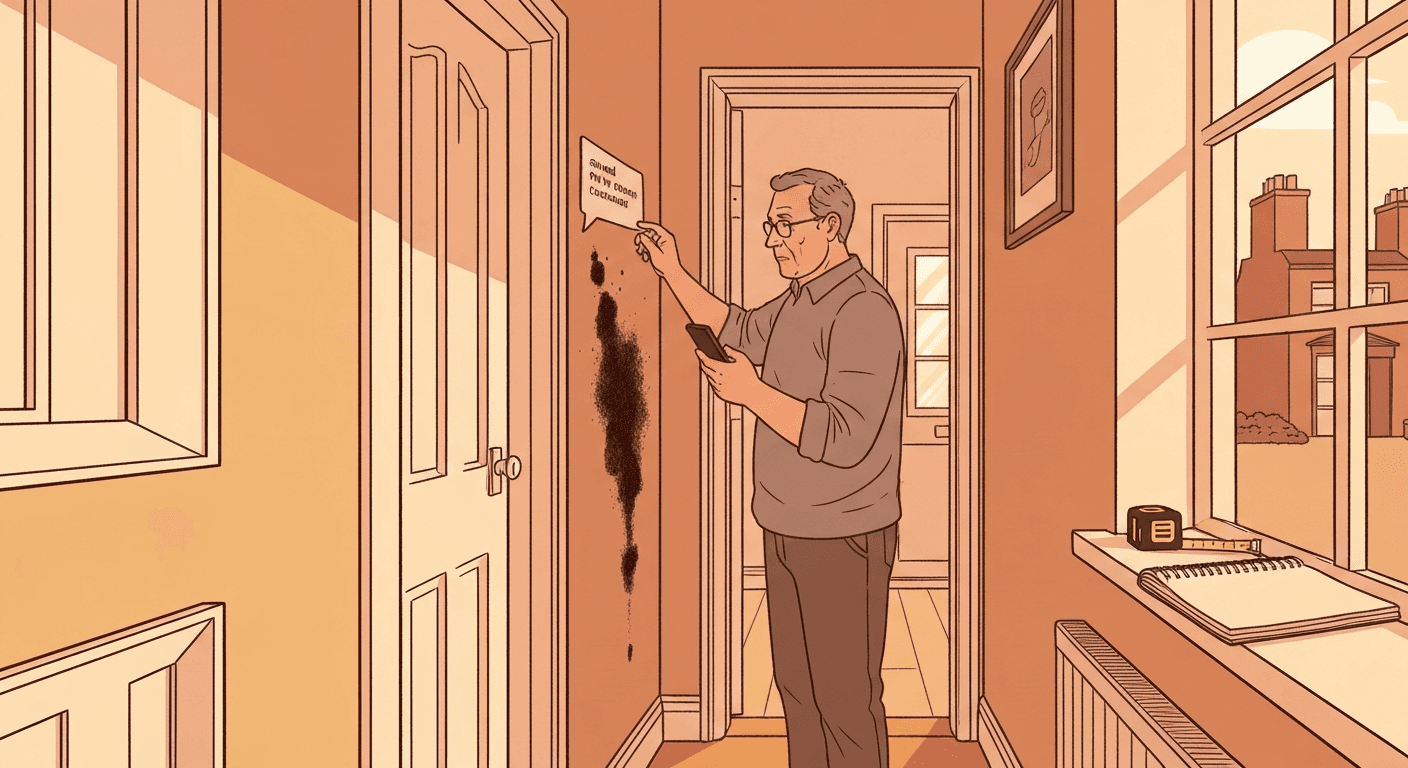
Marcus has three flats in Wolverhampton, two BTLs he picked up over a decade and one HMO he converted from a deceased uncle's house. He runs them from a kitchen table on a Sunday night with a folder of receipts and a Hotmail address. In late 2026 his Flat B tenant emails him a photo of black mould creeping up the bathroom wall and asks, politely but pointedly, "what are you doing about Awaab's Law?" Marcus had vaguely heard the name on the radio. He has no idea what the timescales are, no record of when the message arrived, and no idea what a "written summary" is supposed to look like.
He spends the next three evenings on Property118, the NRLA forum, gov.uk and a half-finished Word doc, trying to work out whether he has 24 hours, 10 days, or 14 days to respond, what counts as an emergency hazard, and whether his council can fine him £30,000 for missing a deadline he didn't know existed. Then a friend in his BTL Facebook group mentions a tool that takes the complaint email, classifies the hazard, starts the statutory clock, drafts the tenant response, and stores the photos in a court-ready evidence pack. Marcus pays £19/month on the spot.
Scores
How does this idea stack up?
7.2/10
Big audience (~1.75M small UK landlords), fragmented, no incumbent owns "compliance for the small private landlord"
Up to £30K civil penalties live now, written into law; landlords overwhelmed by stacked regulation; 96% lack faith in courts
Standard stack, email parsing, vision/LLM classifier, document templates. MVP in 3-4 weeks
Awaab's Law live in social housing Oct 2025; PRS extension legislated for ~2027, two-year build runway with a forced compliance moment
Compliance is permanent, but acute urgency is a 12-24 month window. Big landlord-software incumbents will likely bundle
Low-cost build, but marketing-heavy, reaching 1.75M dispersed small landlords without paid acquisition is the real challenge
Strongest
Timing
There is an explicit, government-published date for when this becomes mandatory in the PRS, and almost no small-landlord-focused tooling exists.
Watch out
Durability
Once the compliance deadline lands and the panic peaks, this risks commoditising into a feature inside Hammock, Landlord Studio or Arthur Online.
Pain Point
The problem
“I have absolutely no idea how I'm supposed to comply with all of this on top of MTD, EPC C, Right to Rent, deposit schemes and the Renters' Rights Act. I've got two flats. I'm one person.”
— Paraphrased composite from NRLA / Property118 forum threads
The core pain is asymmetric regulation. Awaab's Law was written for housing associations with case-management systems, repairs teams, contractor frameworks and hazard data standards (HACT's UK Housing Data Standards now has a damp-and-mould module). Small private landlords have none of that, 84% of UK landlords own four or fewer properties, and most still manage on email, spreadsheets and a personal phone.
The 24/10/3/5 rule is not a vibe, it is a legal timescale. Under the social-housing version: 24 hours to make safe an emergency hazard, 10 working days to investigate a significant hazard (damp/mould, excess cold/heat, fire, structural), 3 working days to send a written summary, 5 working days to start works once a hazard is confirmed. A small landlord who reads a tenant complaint two weeks after it lands has already failed compliance, even if they fix the actual mould.
Civil penalty exposure is already up to £30,000 per breach via the Housing Act 2004 / HHSRS regime; the Renters' Rights Act increases ceilings further (with serious-breach figures up to £40,000 cited in legal commentary). Local authorities issued 110+ damp-and-mould civil penalty notices in 2020-21 across only 38 of 300+ councils, so enforcement is already real, before Awaab's Law expansion.
Renters' Rights Act stacks Awaab's Law on top of EPC C uplift (deferred but coming), Decent Homes Standard for the PRS, abolition of Section 21, MTD for landlords, the new PRS Database and Ombudsman, and licensing schemes. NRLA's own surveys show 96% of landlords lack faith in courts and 31% plan to sell. The gap between regulatory expectation and operational capability has never been wider.
Want reports like this every Thursday?
One validated UK business opportunity per week. Free.