Check planning permission rules for UK homeowners
Know Before You Build
Executive Summary
In a nutshell
An AI-powered tool that answers the UK homeowner's most common question: "Do I need planning permission for this?" Users enter their postcode, property type, and project details, and the tool cross-references local council rules, permitted development rights (GPDO 2015), conservation area restrictions, and Article 4 directions to deliver an instant, plain-English verdict. With ~160,000 householder planning decisions made per year in England alone, and over 25,000 monthly searches for related keywords, the demand is evergreen and enormous. The timing is strong, the Planning and Infrastructure Act 2025 just created fresh confusion, and AI is now mature enough to parse the notoriously complex rule set that "even councils get wrong regularly."
The Story
Meet the user
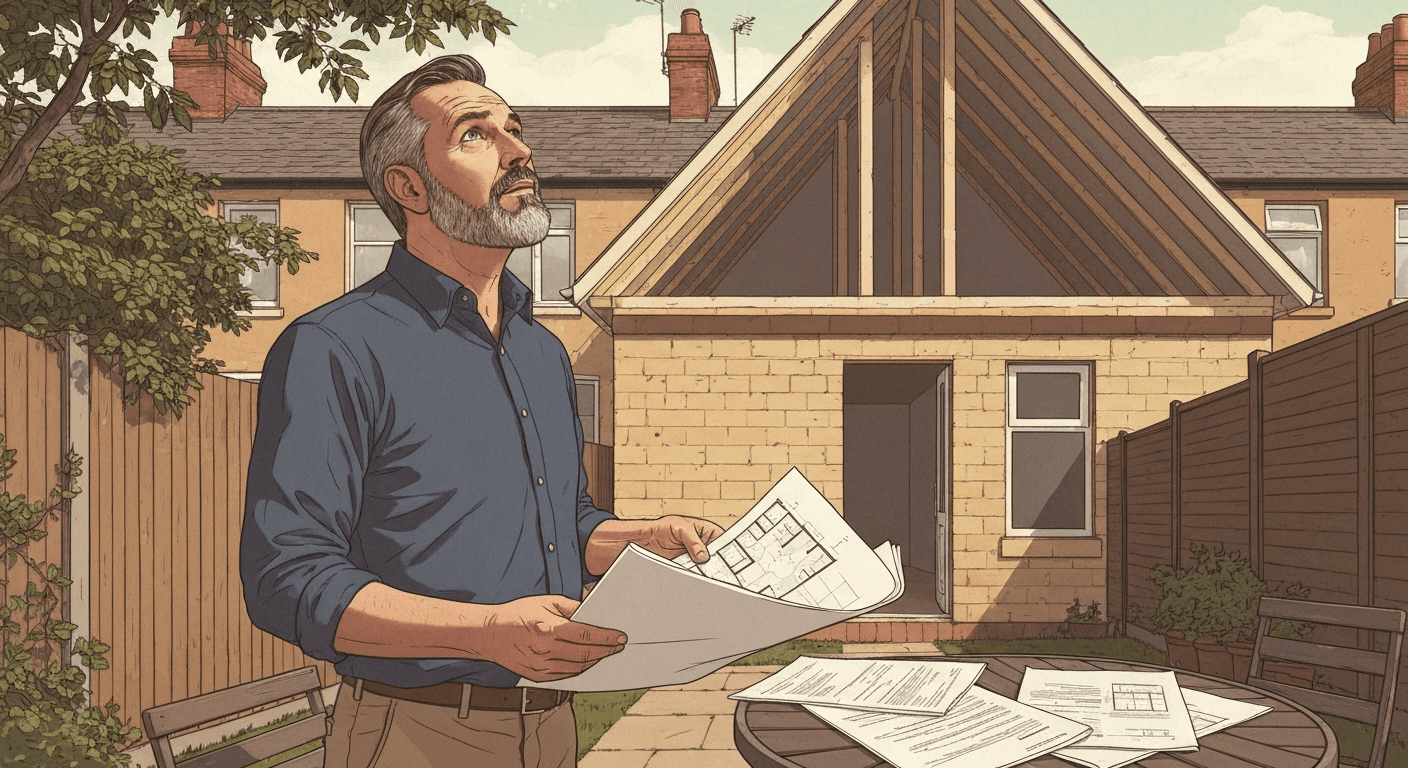
Dave and Priya have been saving for two years to extend their 1930s semi in Sheffield. They want a single-storey kitchen extension, nothing crazy, just enough room for a proper dining table so the kids can do homework while dinner's on. Dave spends a Sunday afternoon on the Planning Portal but comes away more confused than when he started. "Permitted development" sounds like it should be simple, but the rules reference "principal elevations," "original rear walls," and something about measuring height from the "natural ground level adjacent to the extension." Their house is on a slope. They're in a conservation area. Their neighbour's extension seems bigger than what the rules allow. A planning consultant wants £350 just to tell them whether they need permission at all.
Then a friend sends them a link to PlanCheck.ai. They type in their postcode, tick "semi-detached," select "single-storey rear extension," and punch in the dimensions. Thirty seconds later, they have a clear answer: their project falls within permitted development for their property type, but because they're in a conservation area, they need to check for Article 4 restrictions. The tool flags that Sheffield Council has not applied Article 4 to rear extensions in their area. Green light. Dave and Priya book the builder that evening.
Scores
How does this idea stack up?
7.1/10
Large, growing market with clear gaps, 160K+ householder applications/year in England, fragmented competition, no dominant AI-first tool for consumers
Acute frustration, rules are officially described as "lengthy, complex and interlinked" and even councils regularly get them wrong. High search volume for "do I need planning permission" questions
Buildable by a solo developer using open government data (planning.data.gov.uk) and LLM-powered rule parsing, but needs a comprehensive and accurate rule database
Planning and Infrastructure Act 2025 just passed, permitted development rules recently expanded, government pushing 1.5M homes target, fresh confusion and increased demand
Moderate, requires curating rules for 337+ councils, handling conservation areas and Article 4 directions. Not trivial, but achievable with AI tools in 4-6 weeks
Strongest
Timing
The Planning and Infrastructure Act 2025 received Royal Assent in December 2025, creating a wave of new confusion just as AI tools have matured enough to parse complex regulatory rules. This is a "right place, right time" opportunity.
Watch out
Effort to Build
The sheer breadth of council-specific rules, conservation area boundaries, and Article 4 directions means the rule database needs ongoing maintenance. Accuracy is critical because wrong answers could lead to costly enforcement action.
Pain Point
The problem
“Permitted development rights are lengthy, complex and interlinked, and are not always easy to understand, interpret or apply to a given site or scenario, with even local councils getting it wrong on a regular basis.”
— Planning Direct, a professional planning advisory
The pain here is both intense and universal. Every homeowner who considers an extension, loft conversion, conservatory, outbuilding, porch, or even a new fence faces the same question: do I need planning permission? The answer depends on a bewildering matrix of variables.
Property type (detached, semi, terrace, flat), location (conservation area, National Park, AONB, World Heritage Site), Article 4 directions (council-specific restrictions that remove specific PD rights), prior work (previous extensions count against your allowances), measurements (height from "natural ground level," distance from boundaries, percentage of garden covered), and orientation (rules differ for "principal elevations" vs rear vs side).
The government's own Planning Portal offers an "Interactive House" tool, but it provides general guidance rather than property-specific answers. Homeowners currently face three options: DIY research (hours of reading GPDO 2015 technical guidance, often ending in confusion), pay a planning consultant (typically £200-£500 just for a pre-application assessment), or submit a Lawful Development Certificate (costs £103+ and takes 8 weeks, just to confirm you don't need permission). None of these options is fast, cheap, and accurate simultaneously. That is the gap.
Want reports like this every Thursday?
One validated UK business opportunity per week. Free.