ideastack·10 min read·
How to price your first SaaS in the UK
A practical UK guide to SaaS pricing - from psychology and models to VAT, Stripe fees, and when to charge from day one.

Pricing is the single most impactful decision you will make for your SaaS business — and it is the one most founders spend the least time on.
Most builders pick a number that feels right, slap it on a Stripe checkout page, and move on. Six months later they are wondering why they are working 60-hour weeks on a product that barely covers its hosting costs.
This guide is for UK builders shipping their first SaaS product. It covers the psychology behind pricing, the models that work, UK-specific costs you need to account for, and a practical framework for landing on a number you can defend.
Why pricing matters more than features
Here is a number that should change how you think about pricing: a 1% improvement in pricing generates an 11% improvement in profit, on average. That is roughly four times the impact of a 1% improvement in customer acquisition, according to research by Price Intelligently (now Paddle).
Yet most indie SaaS founders spend weeks perfecting their onboarding flow and about fifteen minutes choosing a price.
The reason is psychological. Pricing feels subjective. Building features feels objective. You can measure whether a button works. You cannot easily measure whether GBP19/month is better than GBP24/month — at least not until you have enough customers to run a proper test.
But you can be strategic about it from the start.
Pricing psychology: the basics that actually matter
You do not need a PhD in behavioural economics to price well. You need three principles.
1. Anchor high, then offer tiers
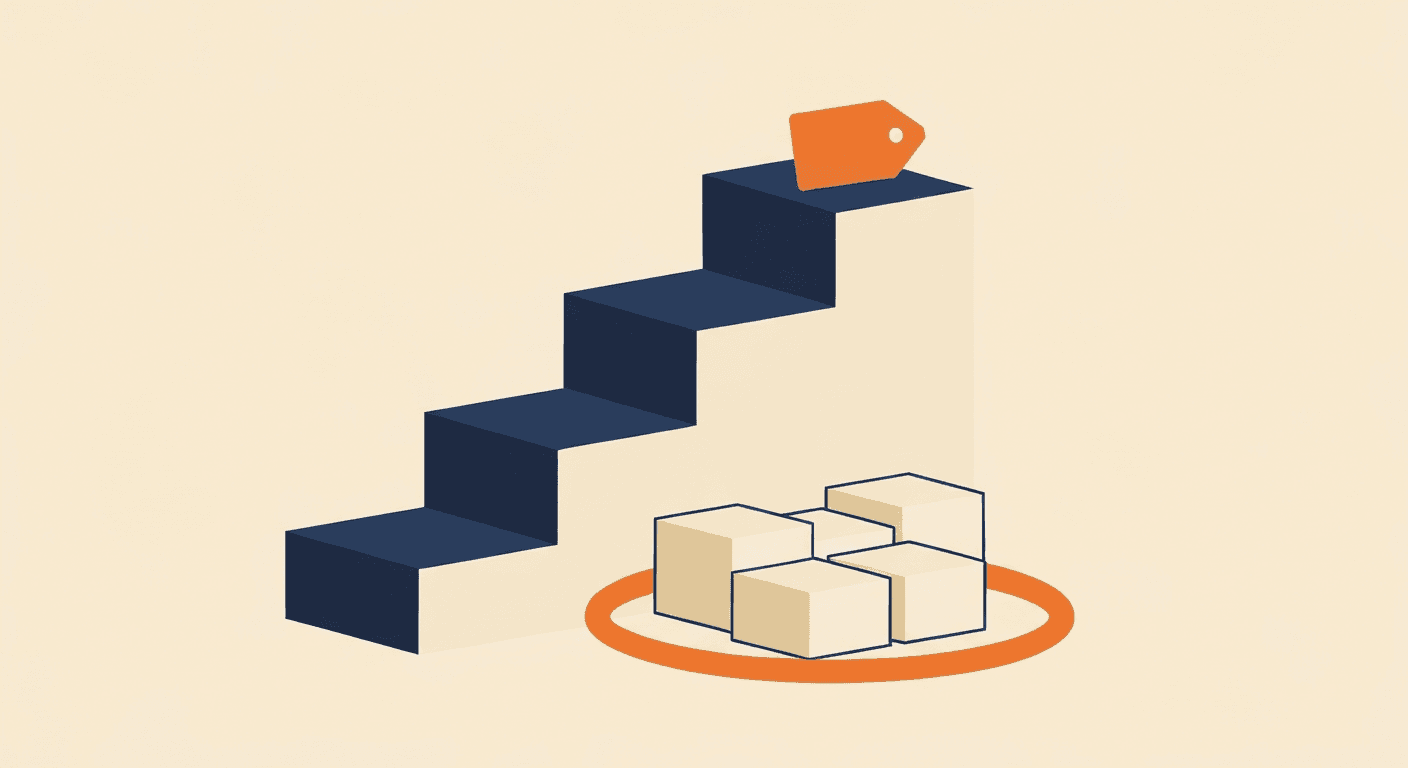
When a customer sees three pricing tiers — say GBP9, GBP24, and GBP49 — they do not evaluate each price in isolation. They compare them to each other. The GBP49 tier makes GBP24 feel reasonable. The GBP9 tier makes GBP24 feel like good value.
This is the anchoring effect, and it is one of the most reliable findings in pricing research. Your highest tier is not primarily there to sell. It is there to make your middle tier look like a smart choice.
Most of your customers will land on the middle tier. Design it to be your most profitable option.
2. Price on value, not cost
Your hosting costs GBP20/month. Your API calls cost GBP5/month. So you price at GBP29/month to cover costs plus a margin. This is cost-plus pricing, and it is wrong for SaaS.
Instead, price on the value you deliver. If your tool saves a freelancer 5 hours per month, and their time is worth GBP50/hour, you are saving them GBP250/month. Charging GBP19-29/month for that is a bargain — and it gives you room to grow your margins as you optimise costs.
The question is not "what does this cost me to run?" but "what is this worth to the person paying?"
3. Round numbers feel premium, odd numbers feel like deals
GBP29/month feels like a deal. GBP30/month feels like a round, premium price. Neither is wrong — it depends on your positioning.
For most early-stage SaaS products targeting small businesses or freelancers, GBP19, GBP29, and GBP49 are the sweet spots. They feel accessible without feeling cheap. For B2B products targeting companies, round numbers (GBP50, GBP100, GBP200) signal confidence.
The four pricing models that work for indie SaaS
Flat-rate pricing
One price, one product. Simple to explain, simple to build, simple to sell.
Example: GBP24/month for unlimited access.
Works when: Your product does one thing well for one type of customer. There is no meaningful difference in how much value different customers extract.
Watch out for: Leaving money on the table. If enterprise customers would happily pay GBP200/month, a flat GBP24 is costing you.
Tiered pricing
Two to four tiers, each with increasing features or limits.
Example: Starter at GBP9/month (100 contacts), Pro at GBP29/month (1,000 contacts), Business at GBP79/month (10,000 contacts).
Works when: Different customer segments extract different amounts of value. This is the most common model for good reason — it captures value across segments while keeping things simple.
Watch out for: Too many tiers. Three is ideal. Four is acceptable. Five is confusing.
Usage-based pricing
Customers pay for what they use. Common in API products and infrastructure tools.
Example: GBP0.01 per API call, or GBP5 per 1,000 transactions.
Works when: Usage correlates directly with value. If a customer sends more emails through your platform, they are getting more value — and paying more feels fair.
Watch out for: Revenue unpredictability. Usage-based pricing makes forecasting harder, and customers often dislike not knowing what their bill will be. Consider a hybrid: base fee plus usage.
Freemium
A permanently free tier with limited features, plus paid tiers for power users.
Example: Free for 3 projects, GBP19/month for unlimited.
Works when: Your product has strong network effects (more users make it better), or you can afford to support thousands of free users while converting 2-5% to paid.
Watch out for: Most solo founders cannot afford freemium. Free users still cost money to support — hosting, customer service, infrastructure. If you do not have a clear conversion path from free to paid, you are running a charity.
UK-specific pricing considerations
VAT: the 20% reality
If you are selling to UK consumers (B2C), your prices must include VAT once you are registered. If you are selling to UK businesses (B2B), you typically show prices excluding VAT and add it at checkout.
The threshold: You must register for VAT when your taxable turnover reaches GBP90,000 in any rolling 12-month period. You can register voluntarily before that — some B2B SaaS founders do, because it lets them reclaim VAT on their own purchases.
The practical impact: If your SaaS reaches GBP7,500/month in revenue, you are approaching the threshold. At that point, 20% of every sale goes to HMRC. Plan for this. If your margins are thin at GBP29/month, they will be razor-thin at GBP24.17/month (GBP29 minus 20% VAT).
Strategy: Set your pricing so it works post-VAT. If GBP29/month is your target, price at GBP29 ex-VAT for B2B customers and GBP35/month inc-VAT for B2C. Or keep prices clean and absorb VAT into slightly higher base prices from the start.
Stripe UK fees
Stripe is the default payment processor for UK SaaS, and for good reason — it is fast to integrate, well-documented, and handles subscriptions natively.
UK card fees: 1.5% + 20p per successful transaction.
European card fees: 2.5% + 20p per transaction.
Non-European card fees: 3.25% + 20p per transaction.
On a GBP29/month subscription charged to a UK card, Stripe takes 63.5p (1.5% of GBP29 = 43.5p + 20p). That is about 2.2% of your revenue. Not huge, but it adds up — on 500 customers that is GBP317.50/month.
Free trial setup: Stripe supports trial periods natively. You can offer 7 or 14-day free trials without charging the card upfront, or collect card details and charge at trial end. The second approach converts better — requiring a card filters out tyre-kickers.
GBP pricing signals trust
If your primary audience is UK builders and businesses, price in GBP. It signals that you understand your market, removes exchange rate anxiety, and builds trust.
Some founders price in USD because "SaaS is global." That is true eventually, but for your first 100 customers, local currency reduces friction. You can add multi-currency support later.

How to research competitor pricing
You do not need to match competitor pricing. You need to understand it so you can position against it.
Step 1: Map the landscape
Find 5-10 competitors or adjacent tools. Check their pricing pages. Note:
- Number of tiers
- Price points
- What differentiates each tier
- Whether they show prices publicly (many B2B tools hide pricing)
- Free trial length and terms
Step 2: Identify the value metric
What do competitors charge based on? Users? Contacts? API calls? Storage? The dominant value metric in your space is likely the one customers expect. Going against it needs a good reason.
Step 3: Find the gap
If every competitor charges GBP30-50/month, there may be room for a GBP15/month alternative that does 80% of what they do. Alternatively, if the market is full of cheap tools, a premium option at GBP99/month with better support and reliability could stand out.
Step 4: Talk to potential customers
This matters more than any pricing page analysis. Ask five people in your target market:
- "What do you currently pay to solve this problem?"
- "What would you expect to pay for a tool that does X?"
- "At what price would this feel too expensive to consider?"
The gap between "what they expect" and "too expensive" is your pricing range.
When to charge from day one vs. freemium
The default answer for solo founders: charge from day one.
Here is why:
-
Paying customers give better feedback. Someone paying GBP19/month has skin in the game. Their feature requests are grounded in real need. Free users request everything and commit to nothing.
-
Revenue validates demand. Ten paying customers at GBP29/month is better validation than 1,000 free sign-ups. Money is the only honest signal.
-
Free users cost money. Hosting, support, infrastructure — even "free" users consume resources. At 100 free users, the costs are trivial. At 10,000, they are not.
-
It is hard to introduce pricing later. If people are used to your tool being free, asking them to pay feels like a betrayal. Starting paid sets expectations correctly.
The exception: Freemium makes sense if your product has genuine network effects (collaboration tools, marketplaces), if you are venture-backed with cash to burn, or if your free tier is so limited that it functions as a permanent trial.
For most UK indie SaaS builders shipping a focused tool, a 14-day free trial followed by paid plans is the right model.
A practical pricing framework for your first SaaS
Step 1: Calculate your value
What problem does your tool solve? How much time or money does it save? Express this as a monthly figure.
Example: Your tool automates invoicing for freelancers, saving 3 hours/month. At GBP40/hour, that is GBP120/month in saved time.
Step 2: Set your anchor
Your price should be 10-20% of the value you deliver. In the example above, GBP12-24/month. This gives your customer a clear ROI — they pay GBP19 and save GBP120.
Step 3: Create three tiers
- Starter: Core features, limited usage. 60% of your anchor price. (GBP12/month)
- Pro: Full features, generous limits. Your anchor price. (GBP19/month)
- Business: Everything, plus priority support or team features. 2-3x your anchor. (GBP49/month)
Step 4: Stress-test the unit economics
At your Pro price, how many customers do you need to cover costs?
- Hosting: GBP30/month
- Domain and email: GBP10/month
- Stripe fees: ~2.2% per transaction
- Your time: priceless, but let us say GBP2,000/month target income
Total: GBP2,040/month. At GBP19/month (minus Stripe fees of ~42p), you need about 110 customers to hit that target. Is that realistic for your market? If yes, the pricing works.
Step 5: Launch and iterate
Set your prices, launch, and watch what happens. If more than 20% of visitors who reach your pricing page convert, you might be too cheap. If fewer than 2% convert, you might be too expensive — or your value proposition is not landing.
Review pricing every quarter. Most early-stage SaaS products are underpriced. It is always easier to offer a discount than to raise prices on existing customers.
Build fast, charge early
The tools available to UK builders today make it possible to go from idea to launched SaaS in a weekend. Claude Code can scaffold your backend, build your API, and deploy to production in hours. That speed is an advantage — but only if you pair it with smart pricing from the start.
Do not treat pricing as an afterthought. It is not a cosmetic decision you slap on at the end. It is a strategic choice that shapes your business model, your customer base, and your ability to sustain the work long enough to succeed.
Pick a price. Launch. Learn. Adjust.
Five things to remember
-
Price on value, not cost. What your tool is worth to the customer matters more than what it costs you to run.
-
Three tiers, middle one is king. Your highest tier anchors the value. Your middle tier is where revenue lives.
-
GBP90,000 VAT threshold. Plan your pricing so margins survive the 20% VAT hit before you reach it.
-
Charge from day one. Paying customers are better validators, better feedback sources, and better for your motivation.
-
Review quarterly, raise confidently. Most SaaS products are underpriced. If nobody pushes back on your pricing, it is too low.
Want to find a SaaS idea worth building? Our latest free report breaks down a real UK opportunity with keyword data, competitor analysis, and a builder prompt to get you started. Read this week's free report →
Frequently asked
Should I price my SaaS in GBP or USD?
If your primary market is the UK, price in GBP. It builds trust with UK buyers and avoids exchange rate confusion. You can always add USD pricing later for international customers.
When do I need to register for VAT?
You must register for VAT when your taxable turnover exceeds GBP90,000 in a 12-month period. Once registered, you charge 20% VAT on top of your prices for UK customers. B2B customers can reclaim VAT, so it matters less for them.
Is freemium a good idea for a solo founder SaaS?
Usually not. Freemium works when you have resources to support thousands of free users while converting a small percentage. For most solo founders, a free trial with a clear end date converts better and costs less to support.
How often should I change my pricing?
Review pricing every quarter. Most early-stage SaaS products are underpriced. If fewer than 10% of prospects push back on price, you are probably too cheap. Raise prices for new customers first and grandfather existing ones.
Should I offer annual discounts?
Yes. A 15-20% discount for annual billing improves cash flow and reduces churn. Offer monthly and annual side by side, with the annual savings clearly highlighted.
Filed under